Decorative Patterns
Classes U–W · Plates LXV–LXXIV

Waves, Swastikas & Steps

Wavy lines, matting and festoons; the swastika classified purely by which way its arms turn; then fluting, steps and pavement mosaics.

Plate LXV — Wavy Lines Zoom
Plate LXV · Class U

Wavy Lines

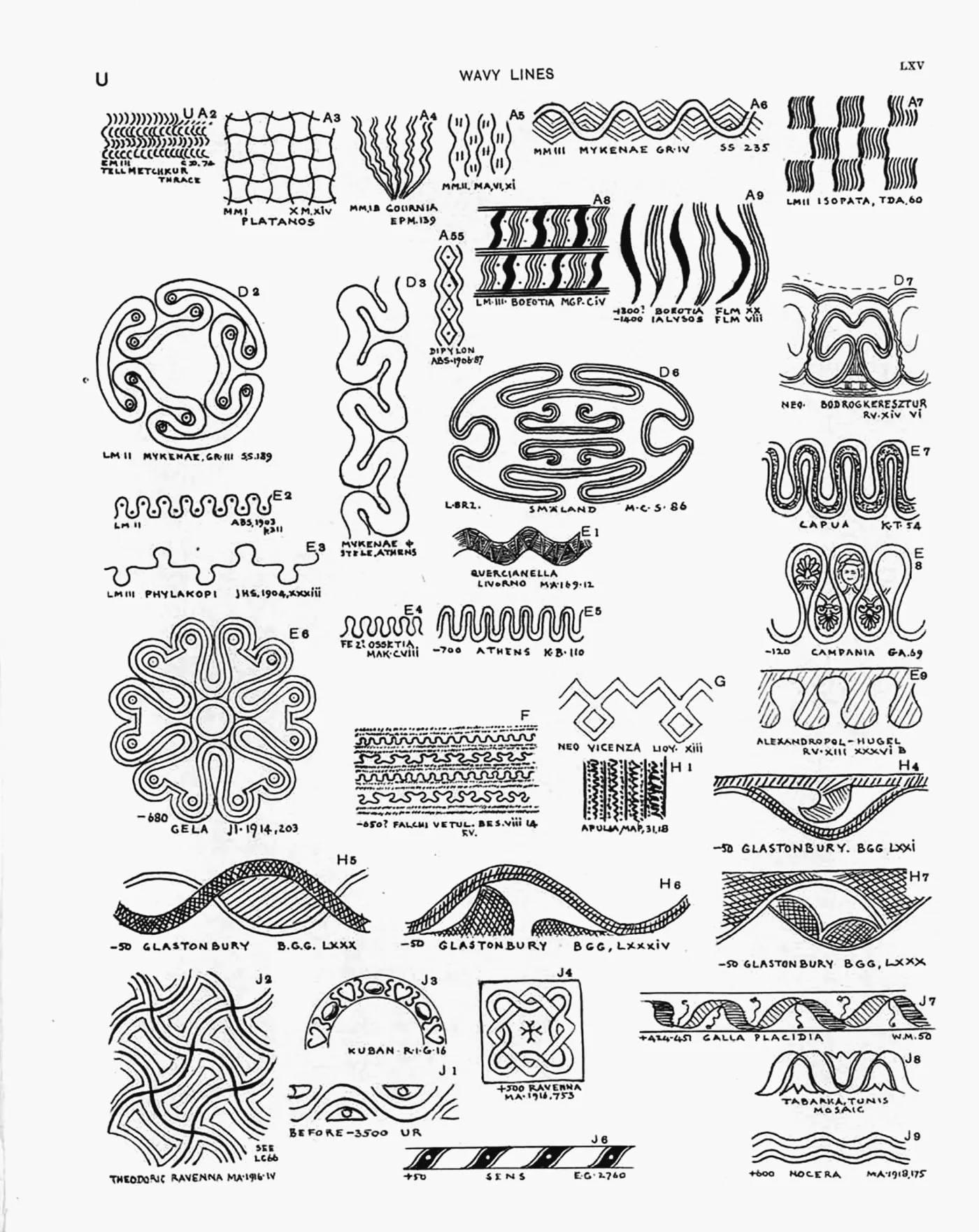
Class U opens with the wave itself, and Petrie leaves it without comment, so the page has to speak for itself. It gathers running waves of every weight: thin Minoan ripples, heavy solid-black S-curves, square-shouldered forms with flat crests, and broad hatched bands from Glastonbury. Several are closed into rings, notably the Mykenaean roundel D 2 and the eight-lobed wheel from Gela, E 6. The lower rows carry the motif into late mosaic and inlay.

on E 8 from campania somebody has set a small face inside each loop of the wave. the pattern did not require this.
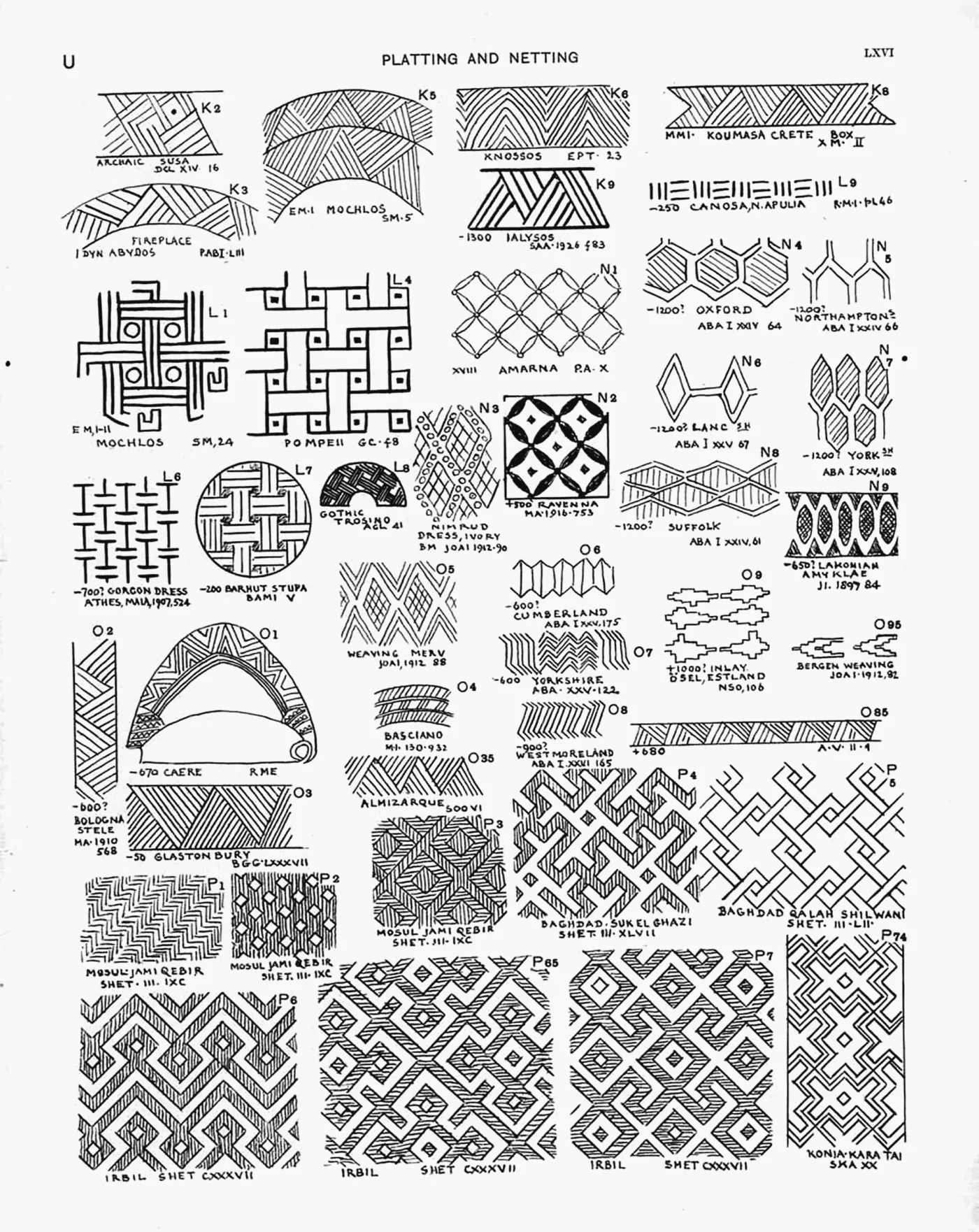
Plate LXVI — Platting and Netting Zoom
Plate LXVI · Class U

Platting and Netting

Petrie reads these as textiles. The family of patterns copied in mediaeval Iraqi brickwork, UP, exists because matting was placed over mud-brick walls to preserve them from weather, so mat patterns came to belong to that kind of building. The net-work patterns from Britain, UN, he takes from the string nets pots were carried in, as in Egypt.

His note runs on to hangings: painted wall drapery was among the commonest subjects, and the striped marble lining Monreale cathedral, each width marked out by a red border, imitates it.

his explanation of the iraqi brickwork amounts to a wall permanently copying its own raincoat.
Plate LXVII — Matting, Festoons, Hangings Zoom
Plate LXVII · Class U

Matting, Festoons, Hangings

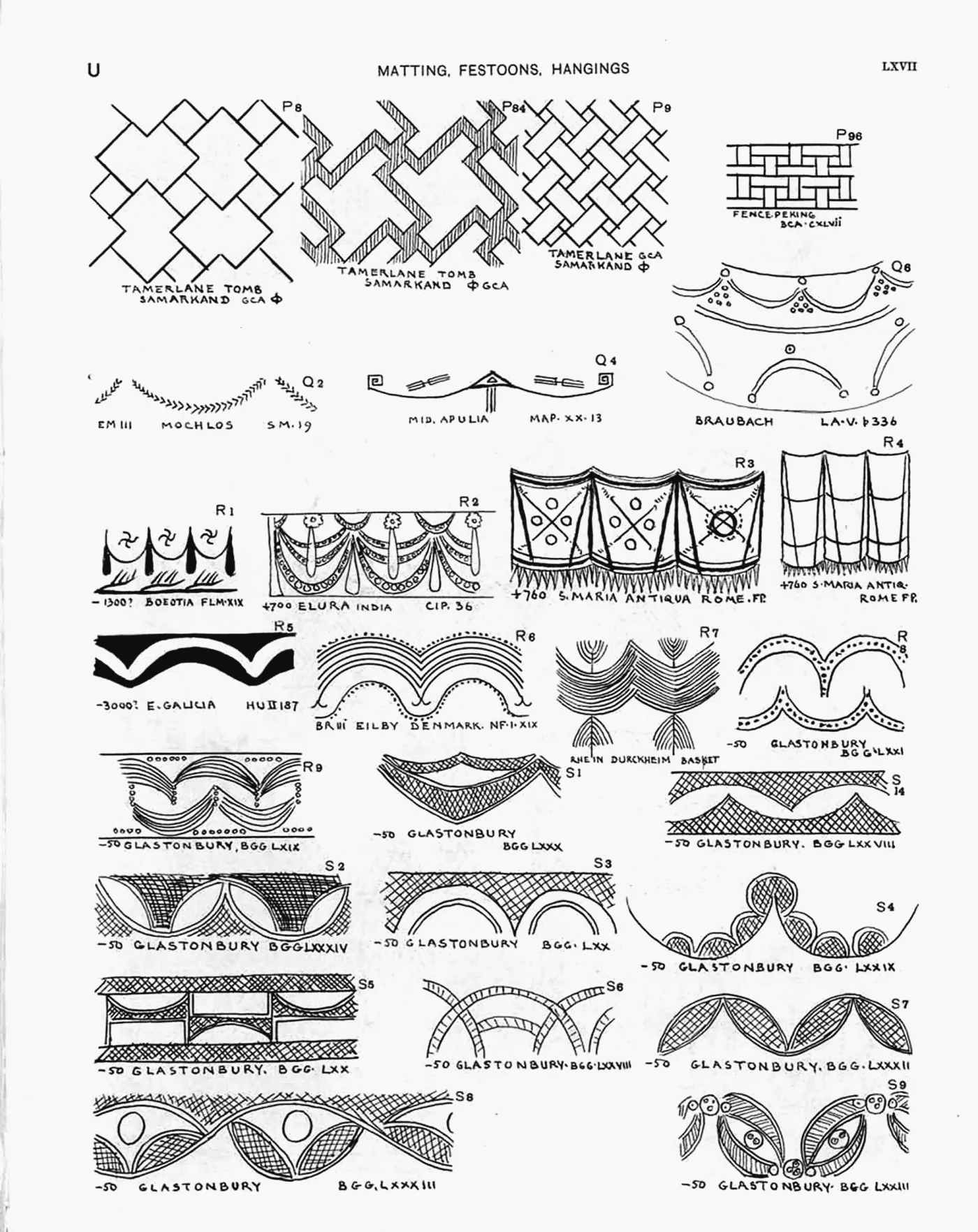
Petrie leaves this plate without a note. The running head names its three subjects and the page keeps them in that order: broad plaited matting at the top, from the Tamerlane tomb at Samarkand and a fence at Peking; then light swags and festoons; then row upon row of hanging bands. The lower two-thirds is drawn in fine cross-hatching, one arc-and-lens variant after another.

most of the bottom half is glastonbury at -50. someone there found an arc they liked and stayed with it.
Plate LXVIII — Zigzags Zoom
Plate LXVIII · Class U

Zigzags

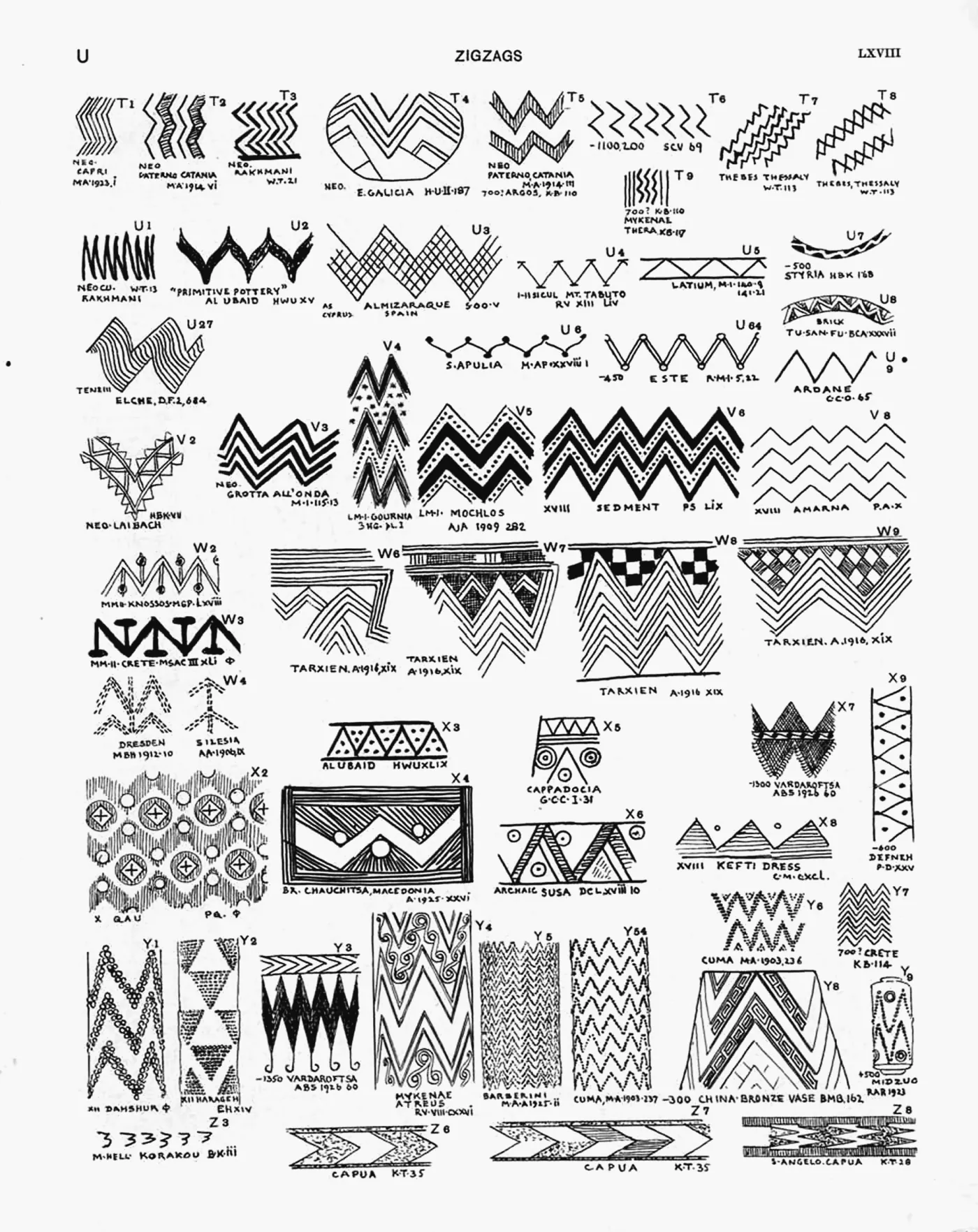
No note from Petrie; the one-word running head is the whole argument. The plate collects the zigzag in every weight the draughtsman could distinguish, from hairline scratches on neolithic pottery through doubled and trebled chevrons to solid black bands, and zigzags filled with checker, hatching or dots. The largest, from Tarxien, are set as bordered panels; the lower rows carry the motif on into painted vases and woven dress patterns.

Plate LXIX — Swastika, A-B Foreward, E-G Backward, J-L Extra Line Zoom
Plate LXIX · Class V

Swastika, A-B Foreward, E-G Backward, J-L Extra Line

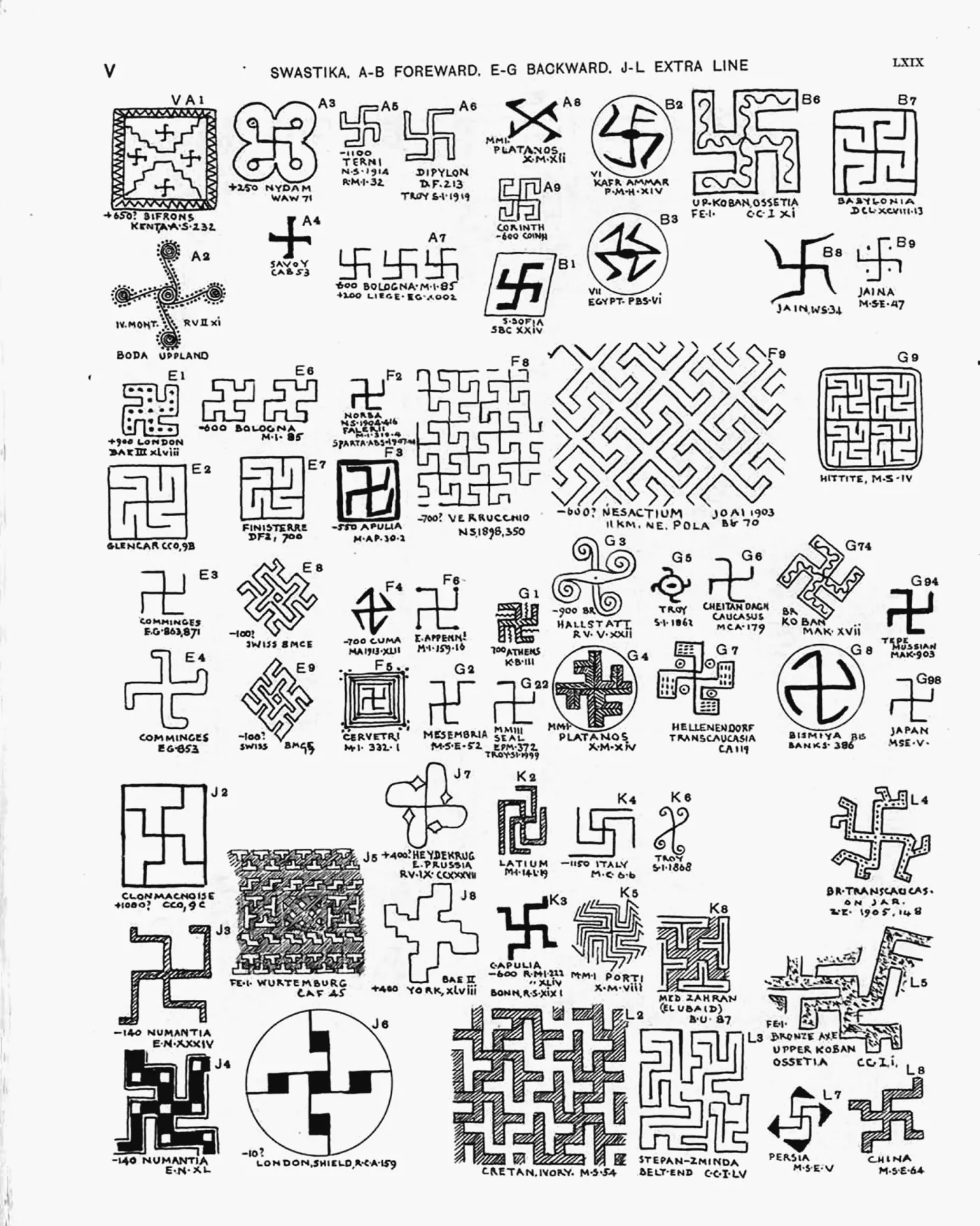
Petrie's classification here is purely geometric. He records that the figure points backward (V; E, F, G) more commonly than forward (V; A, B), and groups the examples first in the simple form, then with one extra bend, and so on up to five bends. Within each group they are arranged geographically from west to east to show the distribution; he holds the eastern to be the earlier source, and refers for the Indian form to Ancient Egypt, 1922, 56.

Plate LXX — Swastika, Extra Lines, Curved Zoom
Plate LXX · Class V

Swastika, Extra Lines, Curved

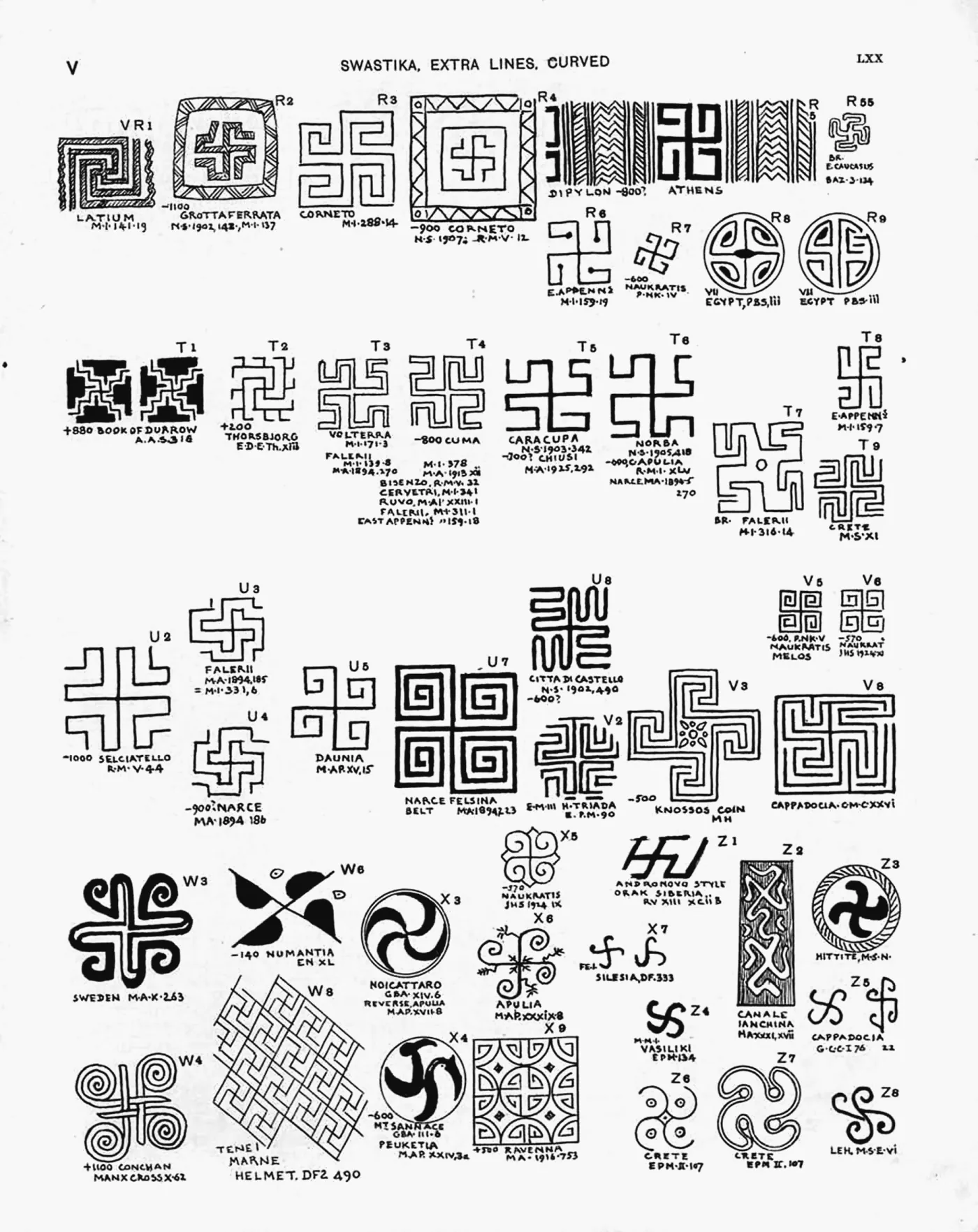
The second half of Petrie's swastika series, carrying the count of extra bends further and then leaving the straight line altogether. The running head marks the division: forms built up with additional lines, then curved versions in which the arms run out as spirals, commas and lobes. The arrangement stays as on the previous plate, grouped by form and set west to east within each group.

Plate LXXI — Fluting, Steps Zoom
Plate LXXI · Class W

Fluting, Steps

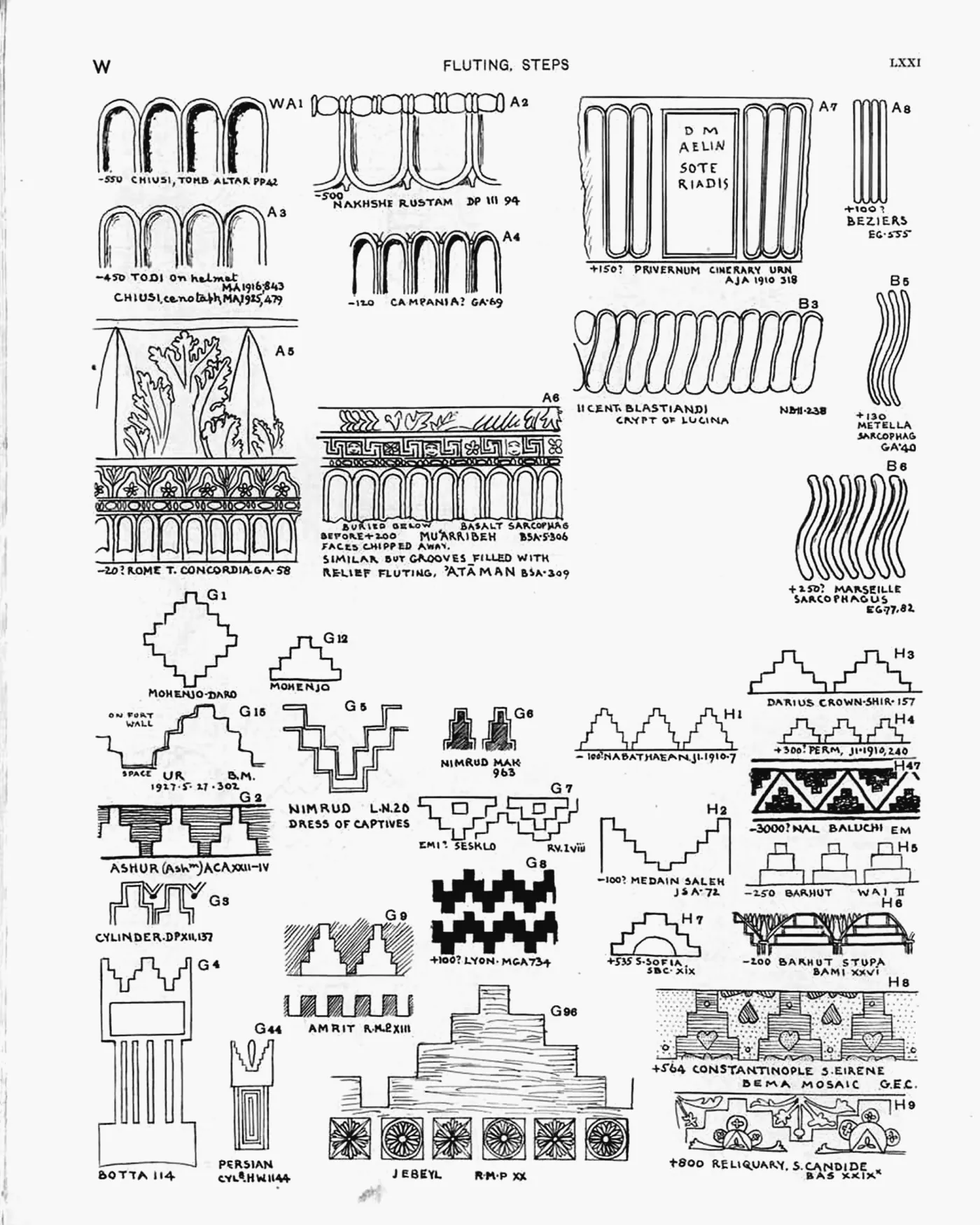
Petrie traces the "strigil" pattern of Roman sarcophagi, WB 6, back to the wide fluting at the head of the plate, W A and B. The step pattern below, W G to K, he calls purely northern, touching the Mediterranean at one corner only, and very persistent: in general use, he writes, from Scotland to China.

It then took possession of gold and garnet work, which had originally been free of it, and ruled the Jutish and Saxon jewellery of England.

a pattern that gets itself from scotland to china while barely touching the mediterranean at all.
Plate LXXII — Step Pattern, Gold and Garnet Zoom
Plate LXXII · Class W

Step Pattern, Gold and Garnet

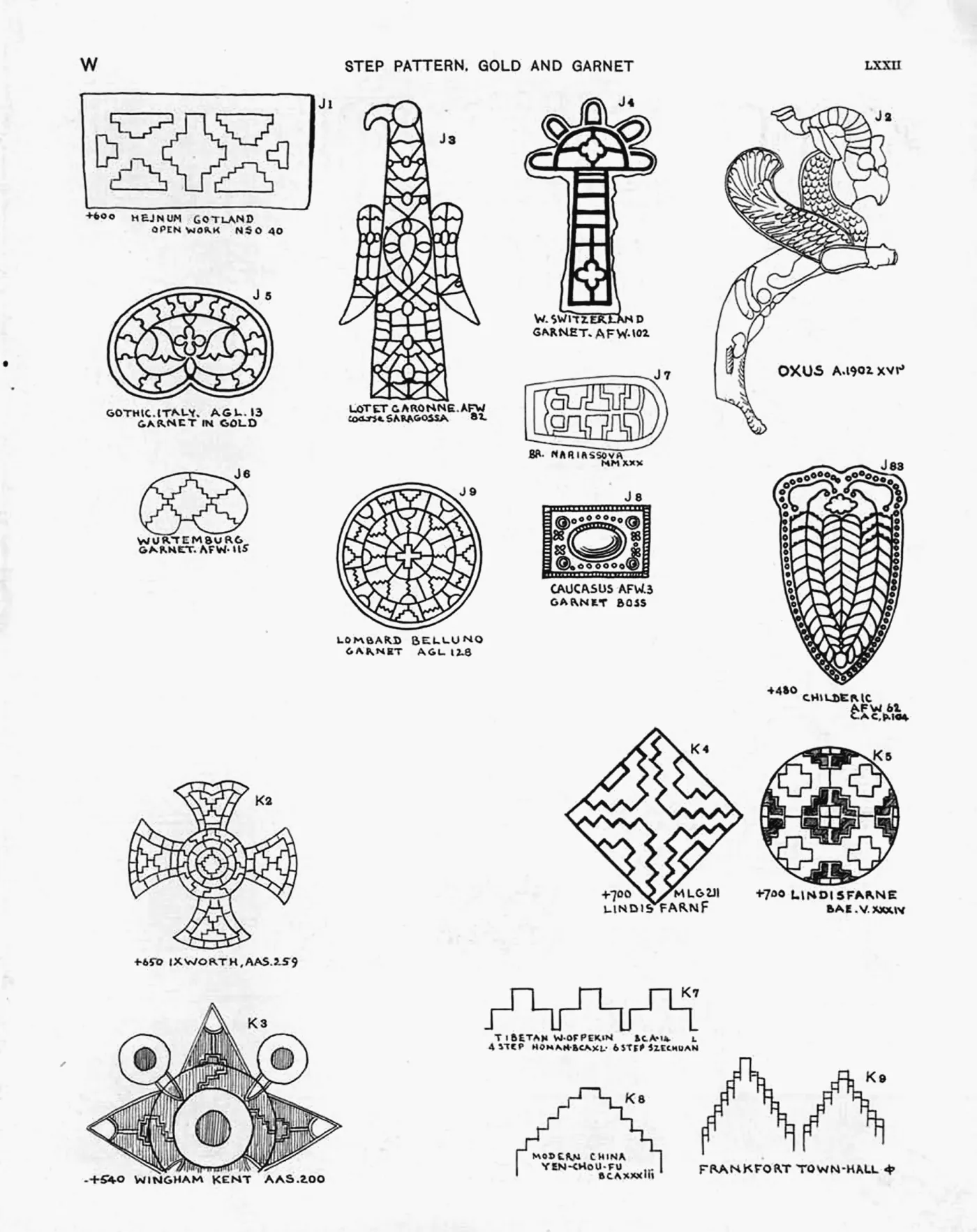
Petrie leaves this plate without a note. It carries the step pattern of the previous page into metalwork: garnet set in gold cell-work, drawn cell by cell. There is openwork from Gotland, a bird-shaped brooch from Lot et Garonne, discs from Belluno and the Caucasus, the Childeric ornament, the Ixworth cross and two Lindisfarne designs. The last few figures leave jewellery for stepped gables and battlements in Tibet, China and Frankfort.

a horned griffin from the oxus has landed in the top corner, the only living thing on a page of cell-work.
Plate LXXIII — Pavement Mosaics 1:1 Angle Zoom
Plate LXXIII · Class W

Pavement Mosaics 1:1 Angle

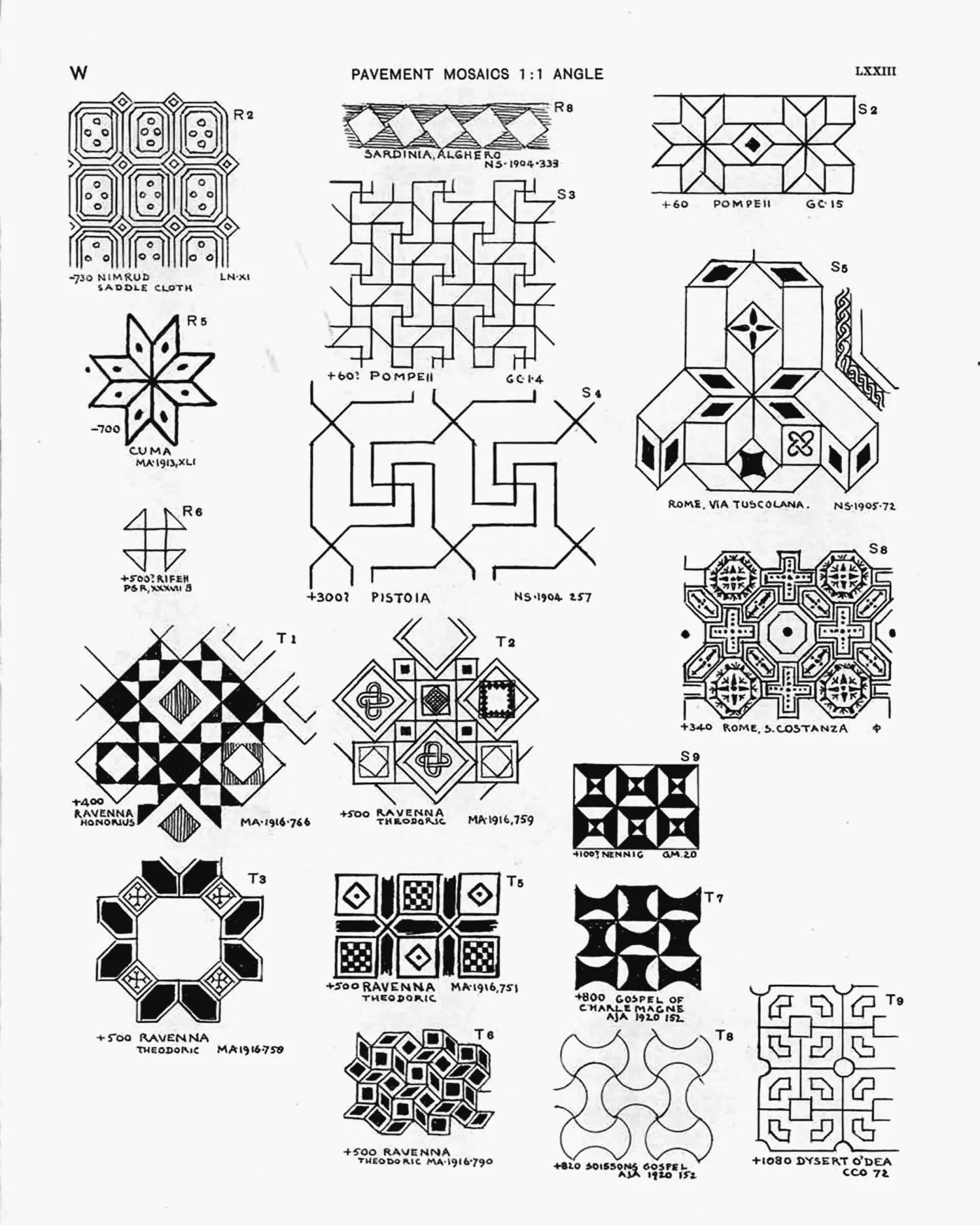
Petrie classes pavement mosaics by the obliquity of the angles they form, from 1:1 up to 1:3. This is the 1:1 group, where the lines meet square or at half a right angle. Within that limit the page runs from an Assyrian saddle cloth and a star from Cuma through Pompeian and Roman floors to the Ravenna pavements of Honorius and Theodoric, and ends in gospel-book panels of about +800.

Plate LXXIV — Pavement Mosaics to 1:3 Angle, Hexagon Zoom
Plate LXXIV · Class W

Pavement Mosaics to 1:3 Angle, Hexagon

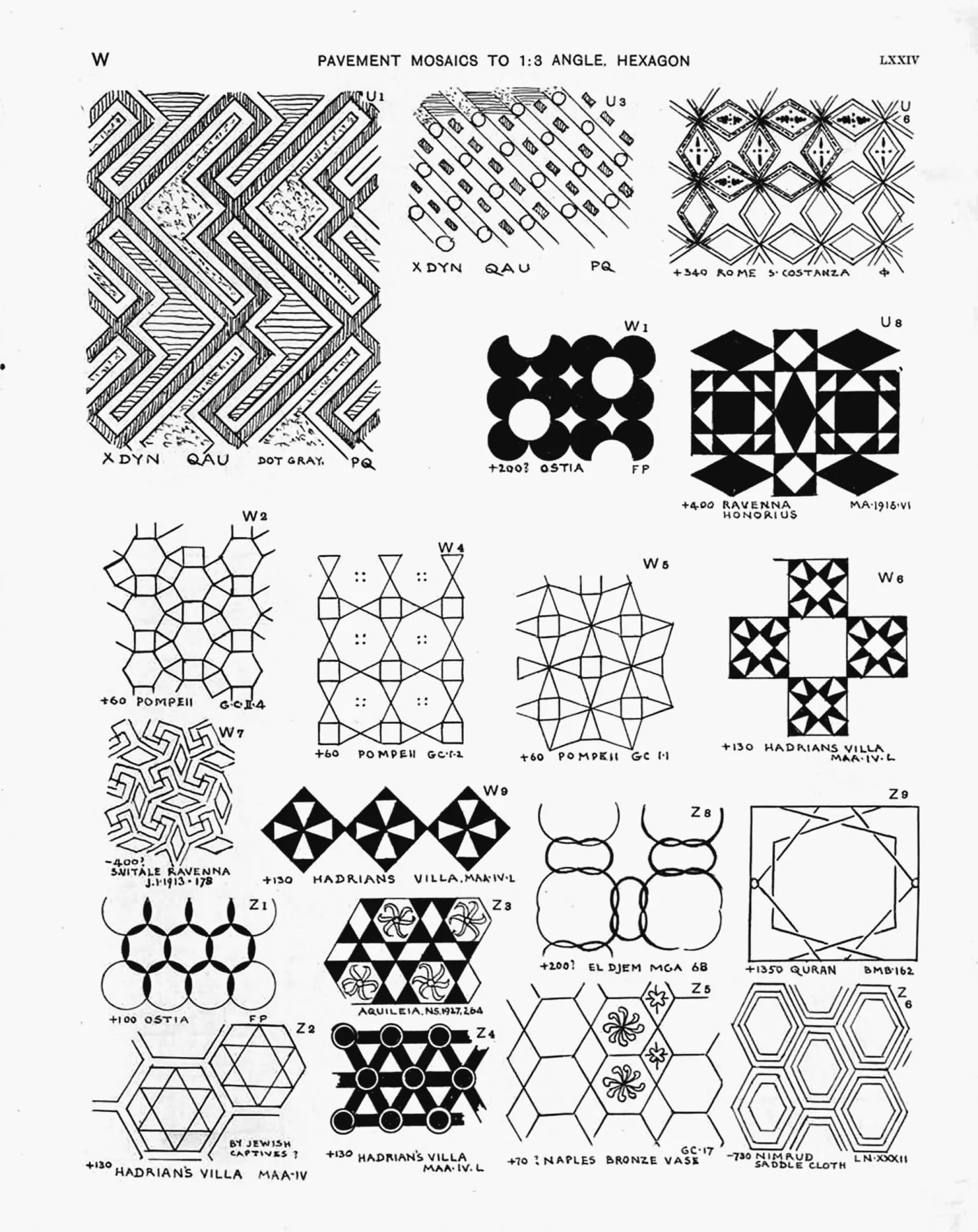
The oblique group, running out to a 1:3 angle, and then the hexagons. Petrie takes the long hexagon of the Assyrian embroidery, Z 6, to be made from two hexagons set one above the other, as in the Naples vase pattern Z 5. Of the Solomon's Seal pattern at Hadrian's Villa, WZ 2, he says it was probably due to Jewish captives employed there.