Decorative Patterns
Classes X–Z · Plates LXXV–LXXXVIII

Keys, Frets & Chequers

The Greek fret and its complications, mazes, T-forms, chequers and decorated squares. The book’s last and longest run.

Plate LXXV — T Form, Reciprocals, Maze Zoom
Plate LXXV · Class X

T Form, Reciprocals, Maze

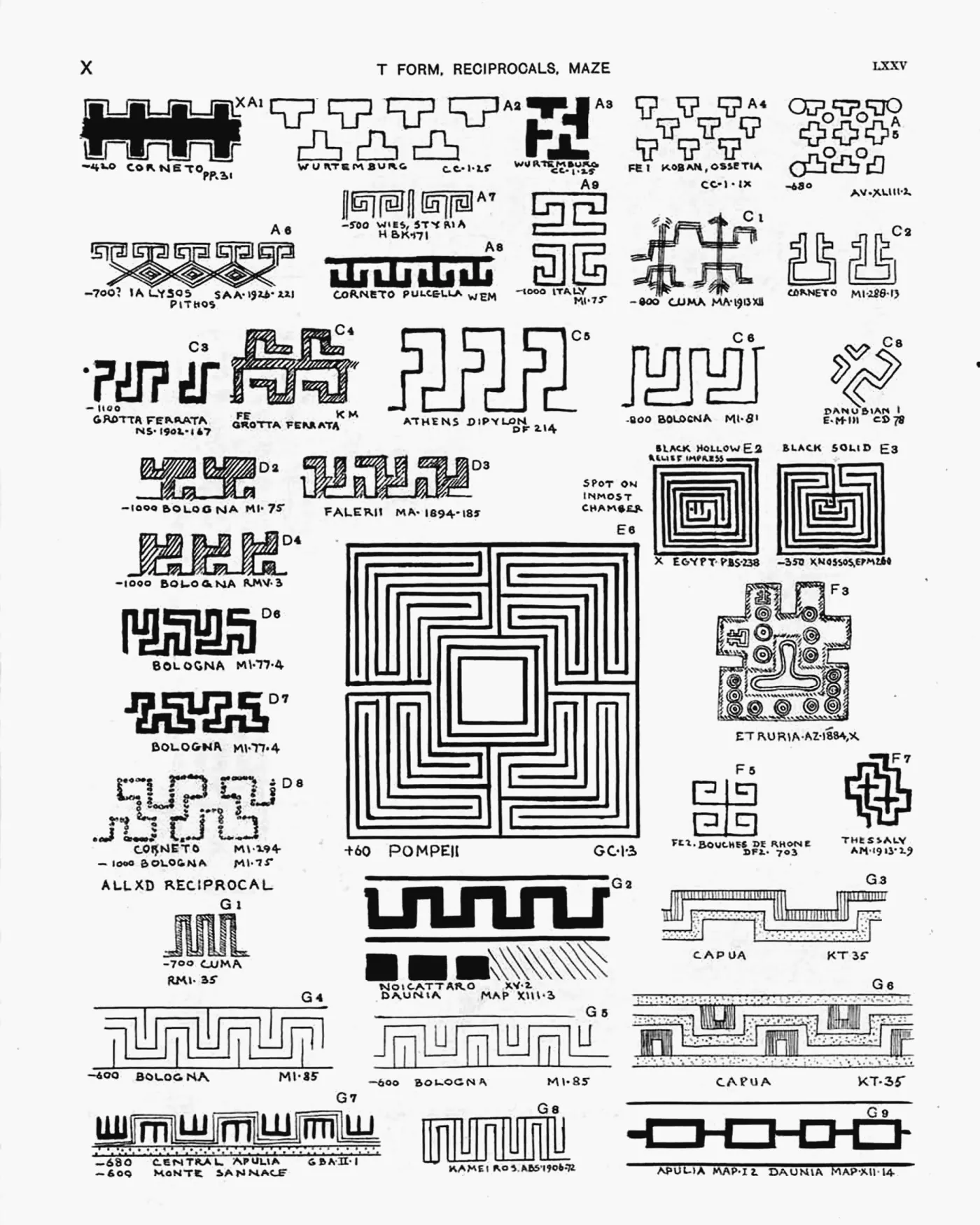
Petrie says the simple key patterns "abound in Italy", but the interesting ones are the reciprocal forms, where the space left between the solids has exactly the same shape as the solids — XA 8, the black band from Corneto Pulcella, and the whole XD row, which the plate itself marks "ALL XD RECIPROCAL".

Three mazes sit in the middle: a small square one from Egypt, XE 2, which he calls the oldest known; one from Knossos; and the large Pompeii pavement, XE 6.

the pompeii maze, he notes, is faulty. the upper left quarter never opens.
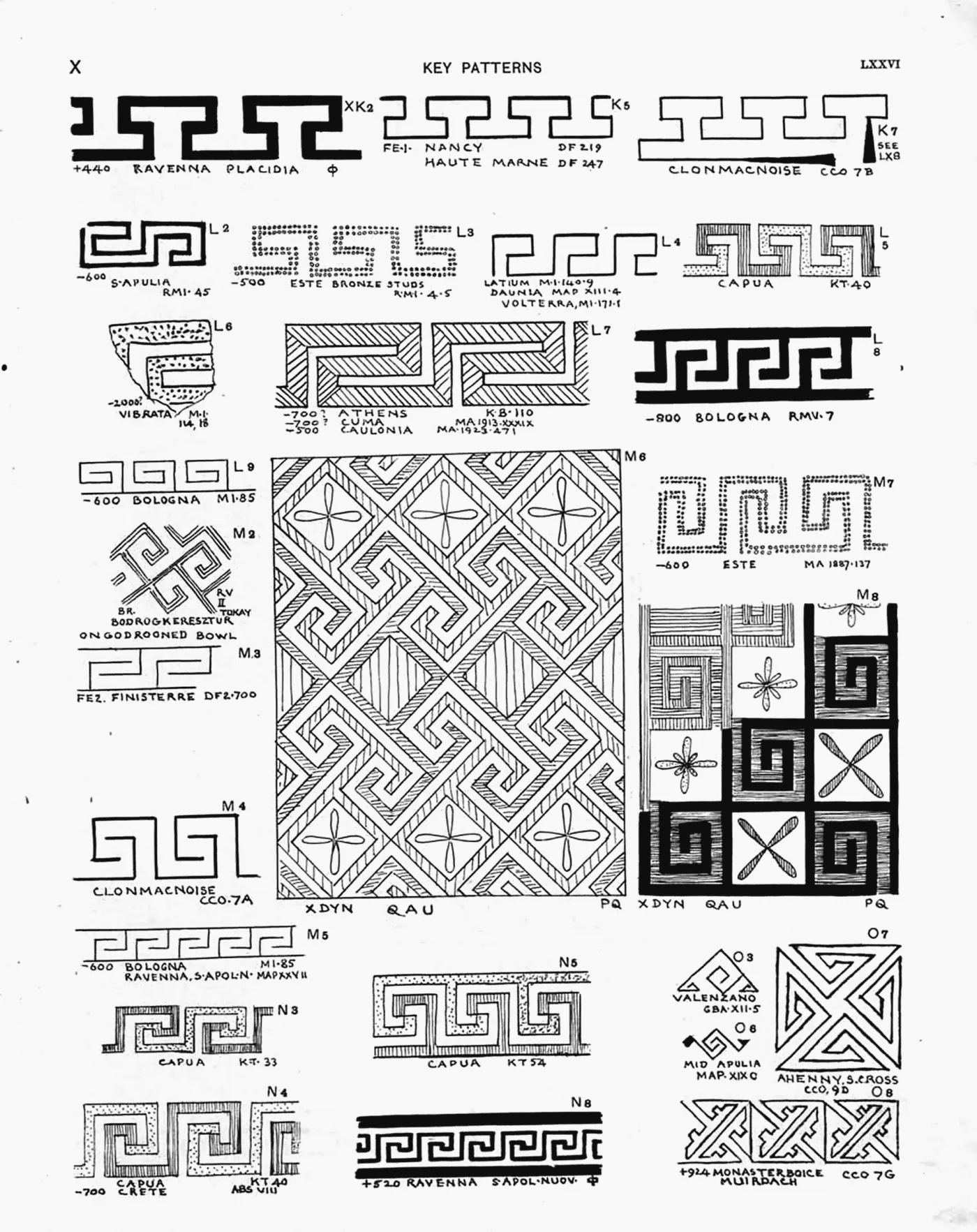
Plate LXXVI — Key Patterns Zoom
Plate LXXVI · Class X

Key Patterns

No note from Petrie. The plate works through his key-pattern families in order — the hollow T (XK), the simple bend (XL), the double bend (XM) and its hollow version (XN), and diagonal settings (XO). The same fret appears in every possible treatment: solid black, outlined, cross-hatched, and picked out in bronze studs at Este.

Two large all-over panels from Qau, X Dyn, hold the middle of the page: one a diagonal fret with four-petal rosettes, the other a chequer of frets and crosses.

Plate LXXVII — Complex Key Patterns Zoom
Plate LXXVII · Class X

Complex Key Patterns

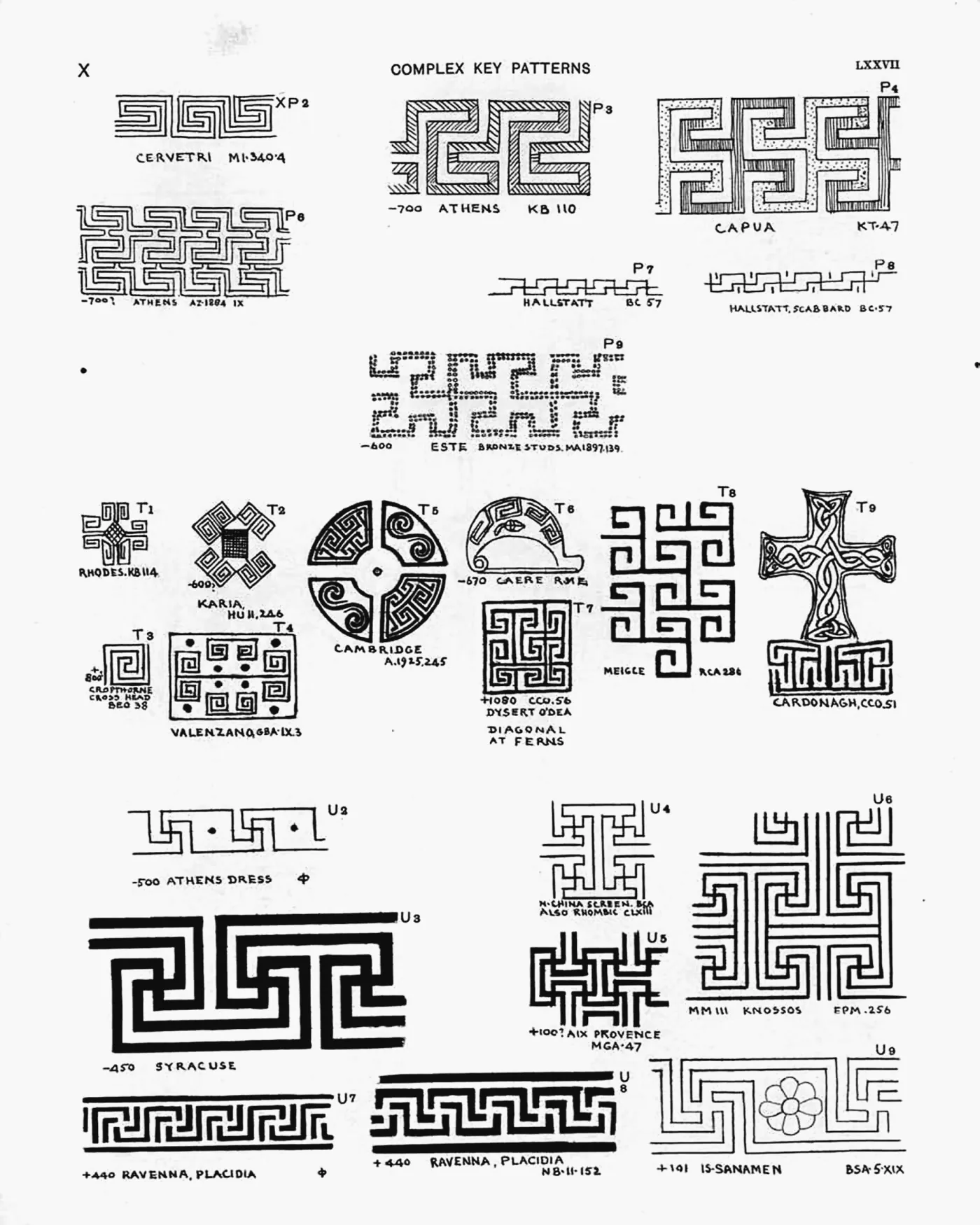
Petrie leaves this one unannotated. It collects the harder versions of the fret: the double series (XP), the complex forms (XT) and the swastika-based keys (XU) — patterns that turn back on themselves twice, or interlock in more than one direction at once.

The range of sources is the point. Hallstatt scabbard borders, bronze studs from Este, a fret-and-spiral disc at Cambridge, the Cardonagh high cross with its interlaced head set on a fret base, a north Chinese screen, and a heavy black meander from Syracuse.

a chinese screen and an irish cross on the same page, which is more or less the argument of the whole book.
Plate LXXVIII — Key and Square, Diagonal Zoom
Plate LXXVIII · Class X

Key and Square, Diagonal

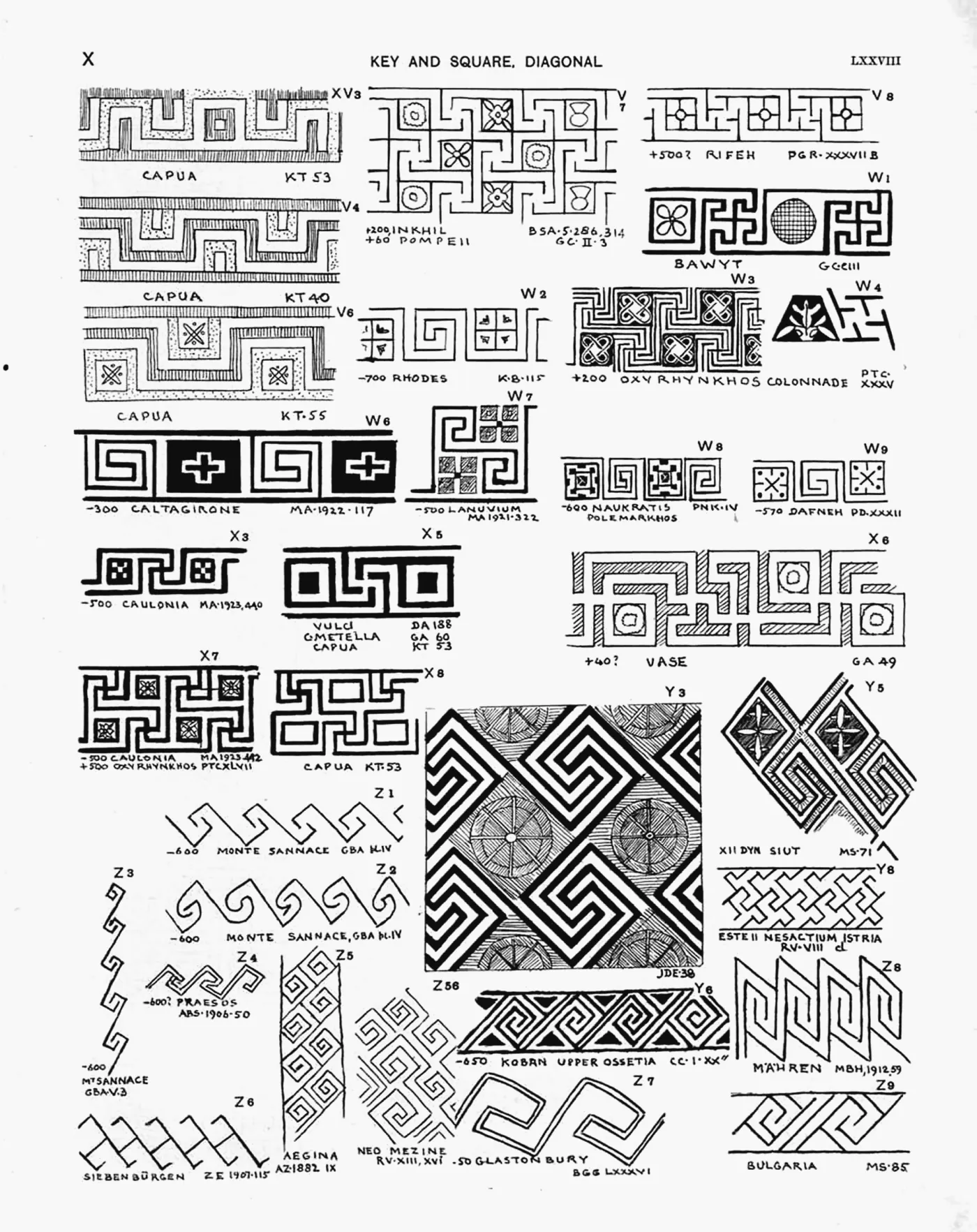
Unannotated. The plate takes the key pattern off the straight and turns it: first frets with squares set into their loops (XV, XW, XX), then frets running diagonally, as filled areas and as bands (XY, XZ).

The centre is held by a bold black-and-white diagonal fret panel with two spoked medallions. Around it are Capua wall-bands, a XII Dyn piece from Siut, a Koban belt from Upper Ossetia, and zig-zag key borders from Monte Sannace, Aegina, Glastonbury and Siebenbürgen.

Plate LXXIX — Chequers, Squares Zoom
Plate LXXIX · Class Y

Chequers, Squares

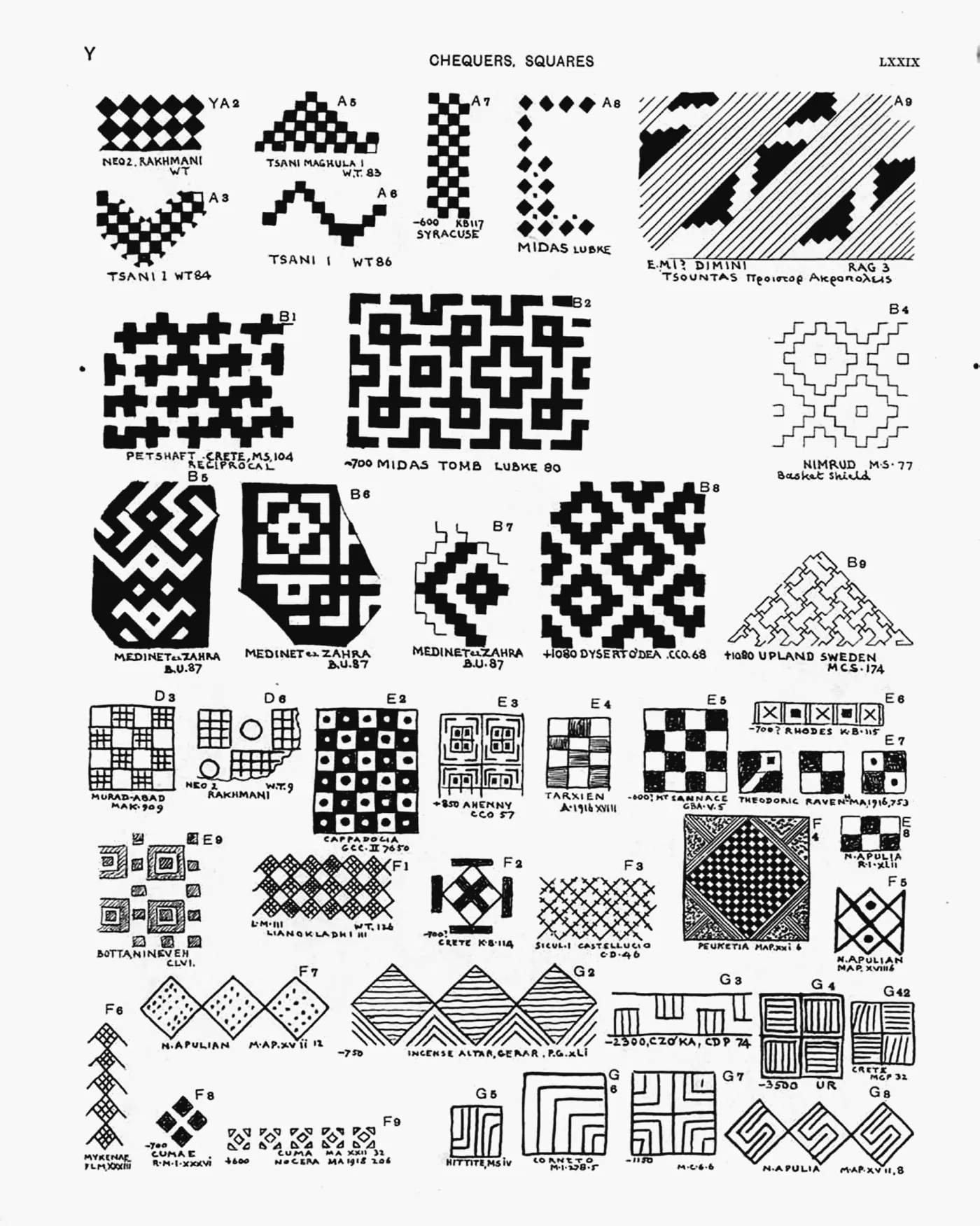
The opening of class Y, "Divided Squares", and Petrie left it without comment. The sequence is legible on the page all the same: simple stepped blocks (YA) from Rakhmani, Tsani and Dimini, then complex blocks (YB) including the Midas tomb and three panels from Medinet ez-Zahra, then systems of squares, ornate squares, and squares filled with parallel lines.

Nearly everything is built up square by square rather than drawn as a line, which gives the page its dense chequerboard look.

Plate LXXX — Squares, Diagonal, Cross Zoom
Plate LXXX · Class Y

Squares, Diagonal, Cross

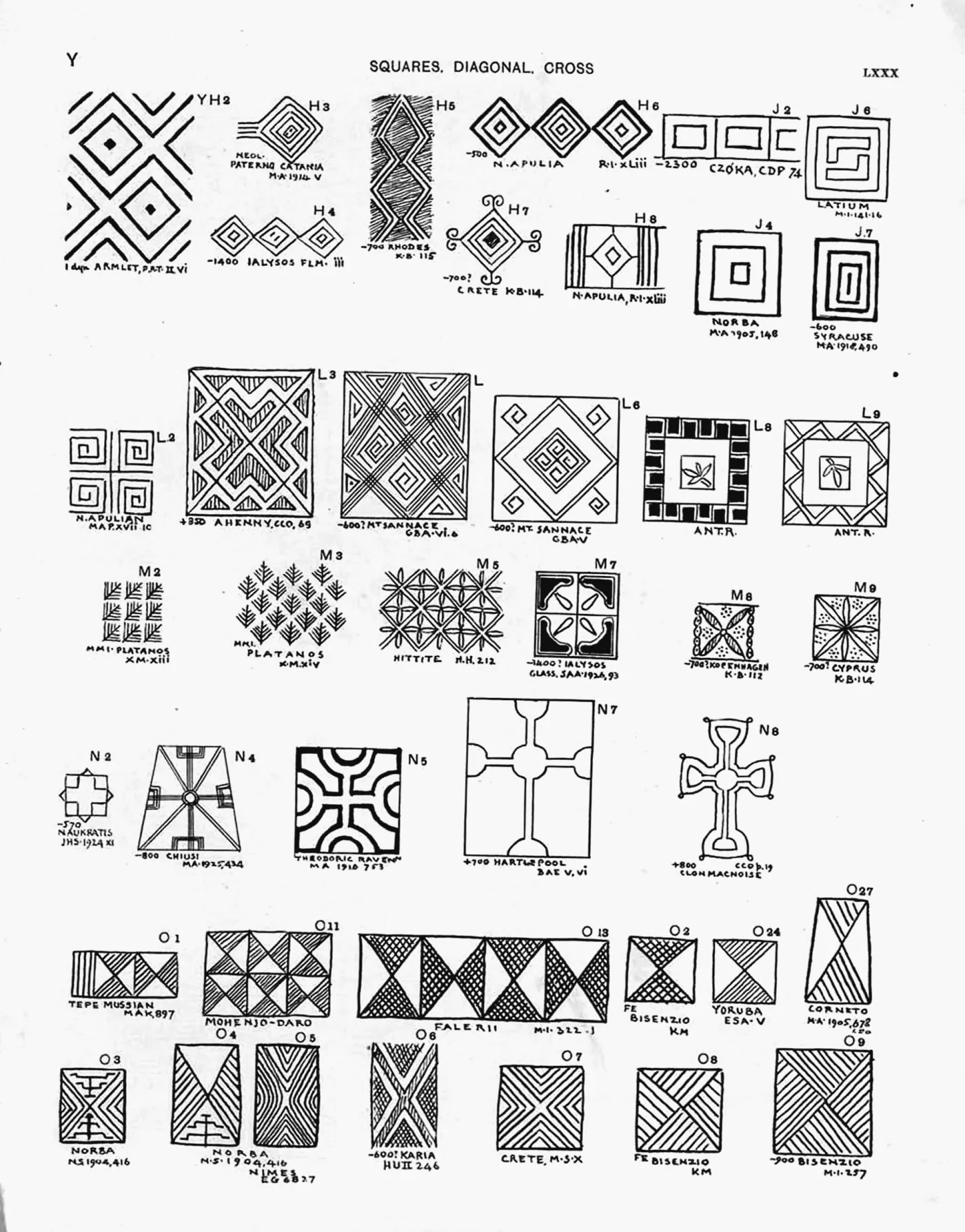
Petrie's single comment here traces a pedigree. The expanded cross on the Hartlepool stone, YN 7, is derived from the Ravenna type, N 5, and that, he says, "obviously came from an Etruscan origin", N 4, the piece from Chiusi. All three are drawn on the same row of the plate.

The rest runs diagonal squares (YH), included squares (YJ), fret squares (YL) and decorated squares (YM), closing with a long row of squares split by their diagonals.

chiusi at -800, hartlepool at +700. petrie files them one row apart.
Plate LXXXI — Squares, Diagonal Division Zoom
Plate LXXXI · Class Y

Squares, Diagonal Division

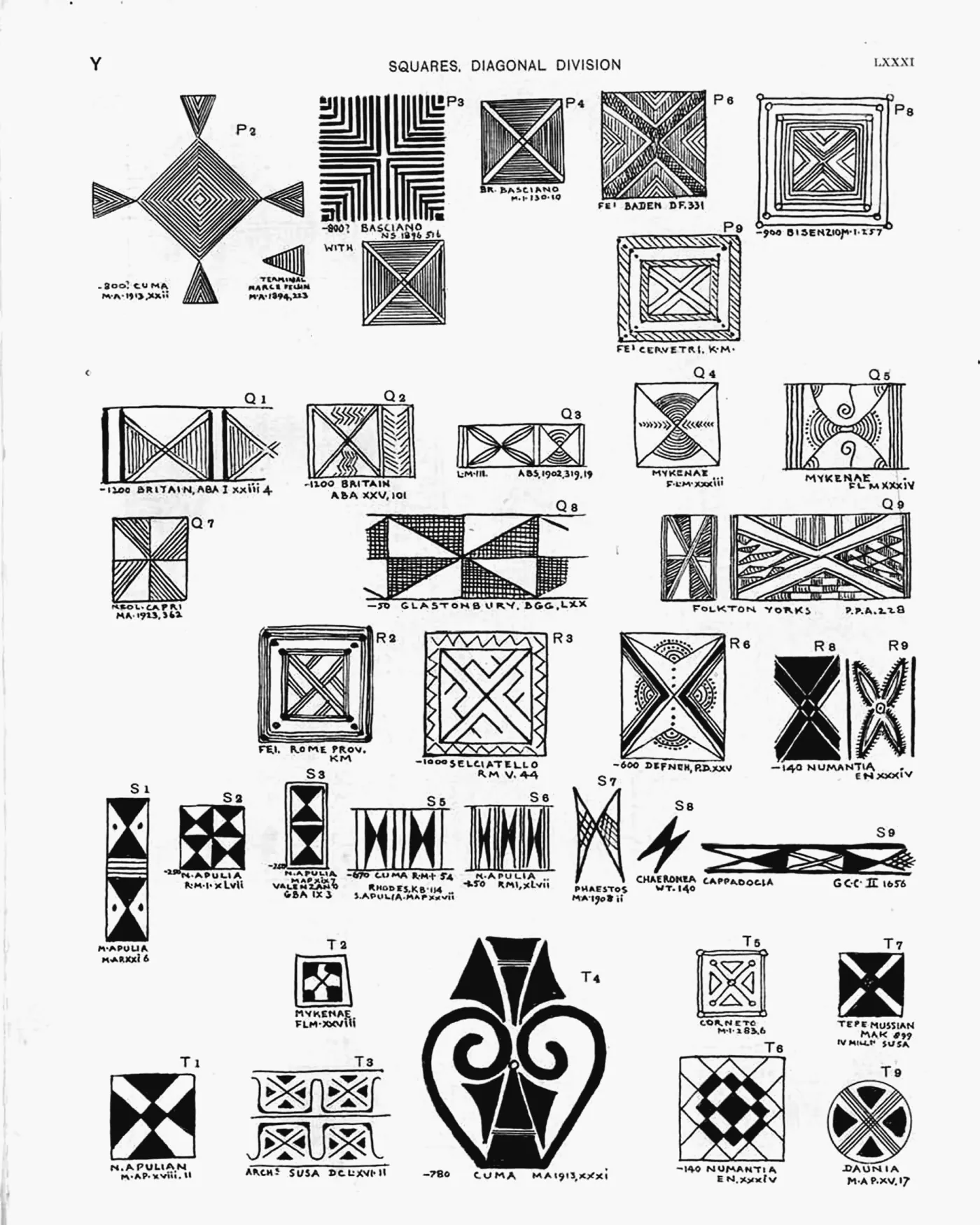
No note. The whole page is one idea worked through: a square cut by its diagonals, and what can be done with the four triangles that result. Quarters hatched in opposing directions (YQ), quarters filled with pattern (YR), quarters blacked in alternately (YS), quarters arranged cruciform (YT).

The sources sit oddly together — Britain at -1200, Folkton in Yorkshire, Mykenae, Numantia, Susa, and a large black Cuma design at the foot of the page.

an entire plate on the consequences of drawing an X inside a box.
Plate LXXXII — Squares Decorated Zoom
Plate LXXXII · Class Y

Squares Decorated

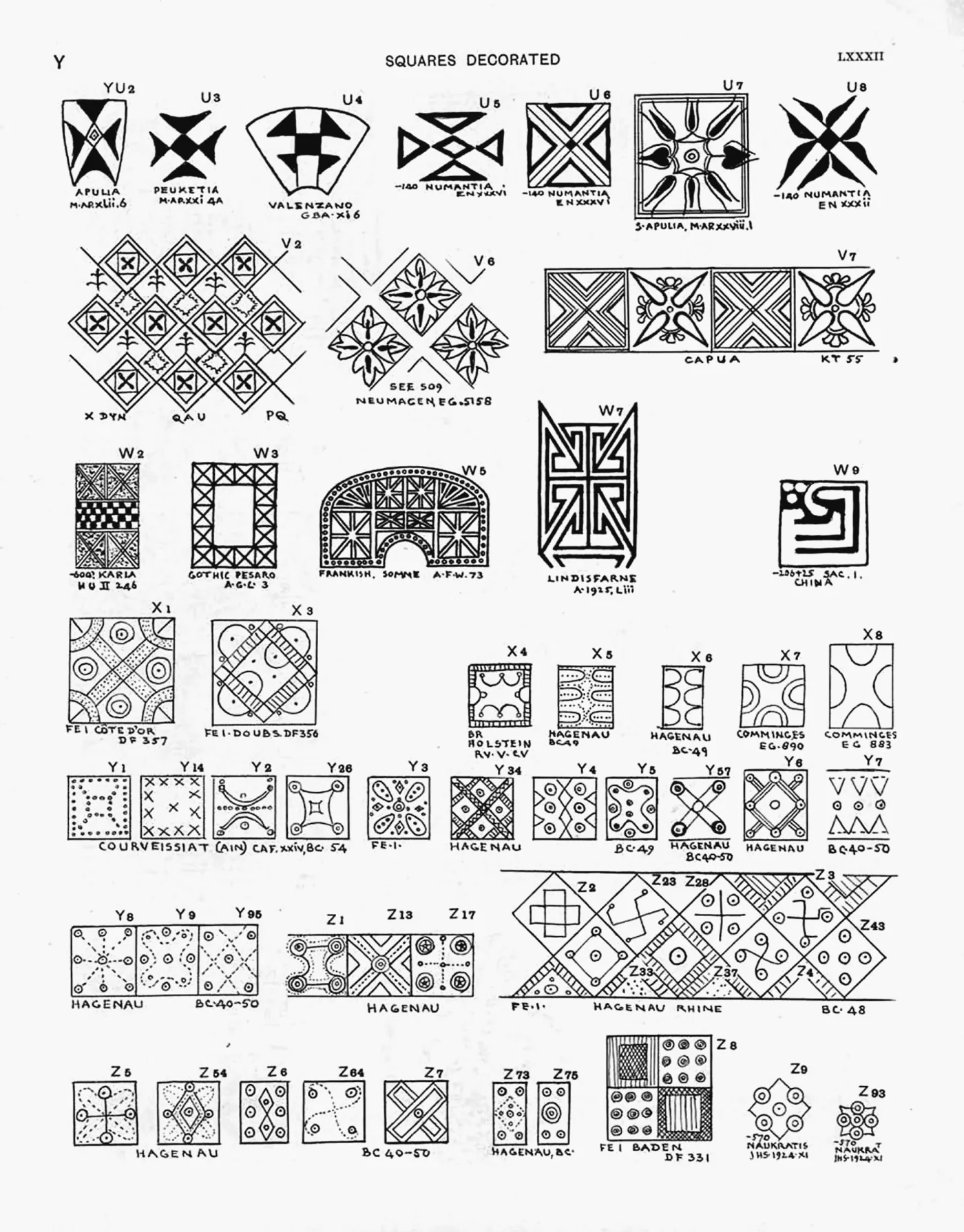
Two remarks from Petrie. The arched Frankish panel from the Somme, YW 5, "seems to have been copied from a grating above a doorway" — it is drawn as a latticed arch with an opening cut into its base. And the small squares of varied content in the YY and YZ rows, mostly from Hagenau and the Rhine, "show what the Celt did before he acquired the spiral or interlaced forms": dots, crosses, saltires and odd strokes inside plain boxes.

the celtic "before" pictures are four dots in a box. he catalogued them anyway.
Plate LXXXIII — Metopic Lines, Joggles Zoom
Plate LXXXIII · Class Z

Metopic Lines, Joggles

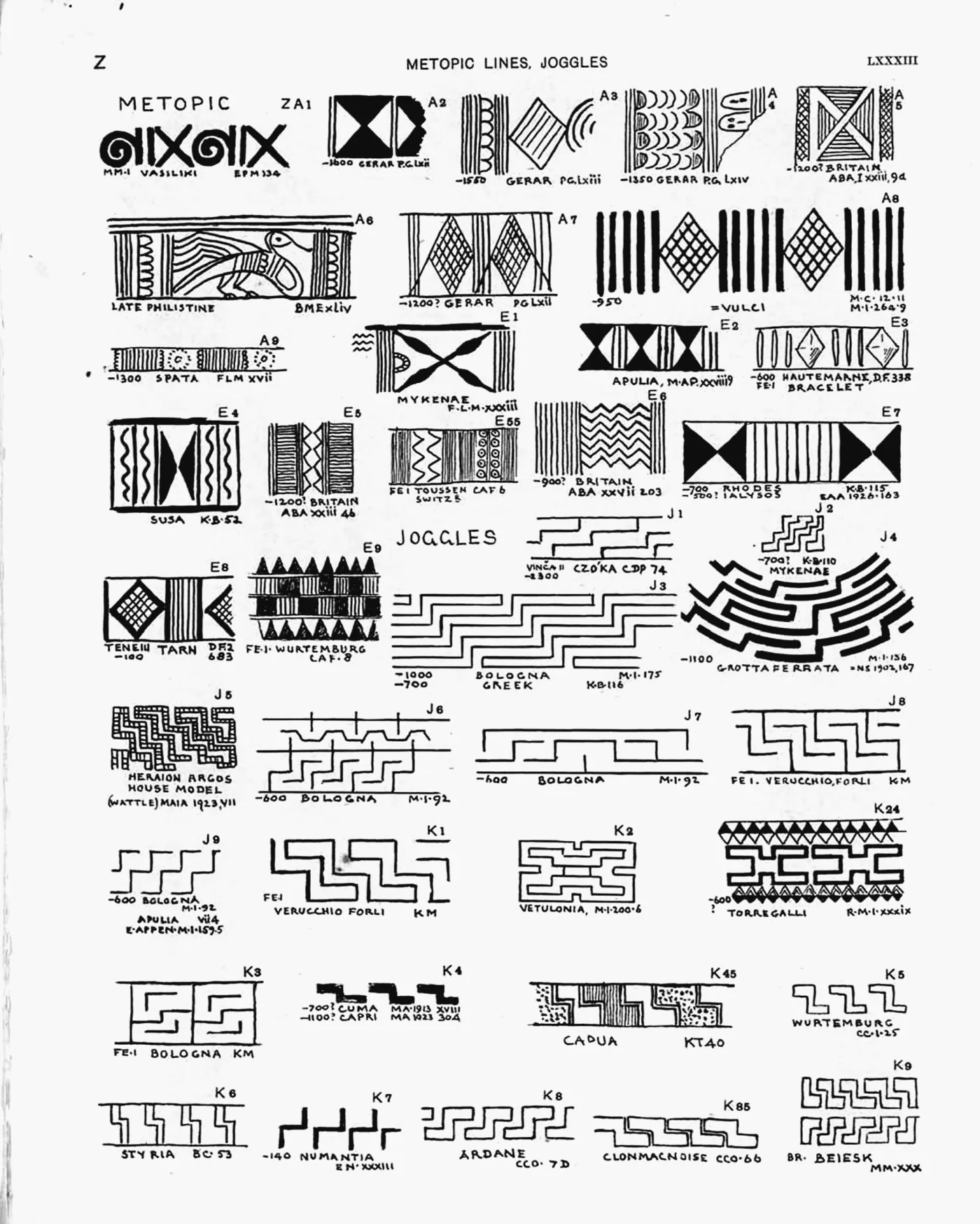
Petrie's argument: the metopic series ZA to ZE — groups of vertical bars separating panels of design around a vase — precedes by a thousand years the architectural use of parallel lines between groups. There is no meaning in grooving the ends of roof beams, he points out; the device was already well fixed in vase painting, and was simply transferred to a similar duty in the building.

The lower two-thirds turns to joggles: stepped and interlocking line borders from Bologna, Vetulonia, Grotta Ferrata and Clonmacnoise.

architecture, he implies, got its stripes second-hand from a pot.
Plate LXXXIV — Right Angles Zoom
Plate LXXXIV · Class Z

Right Angles

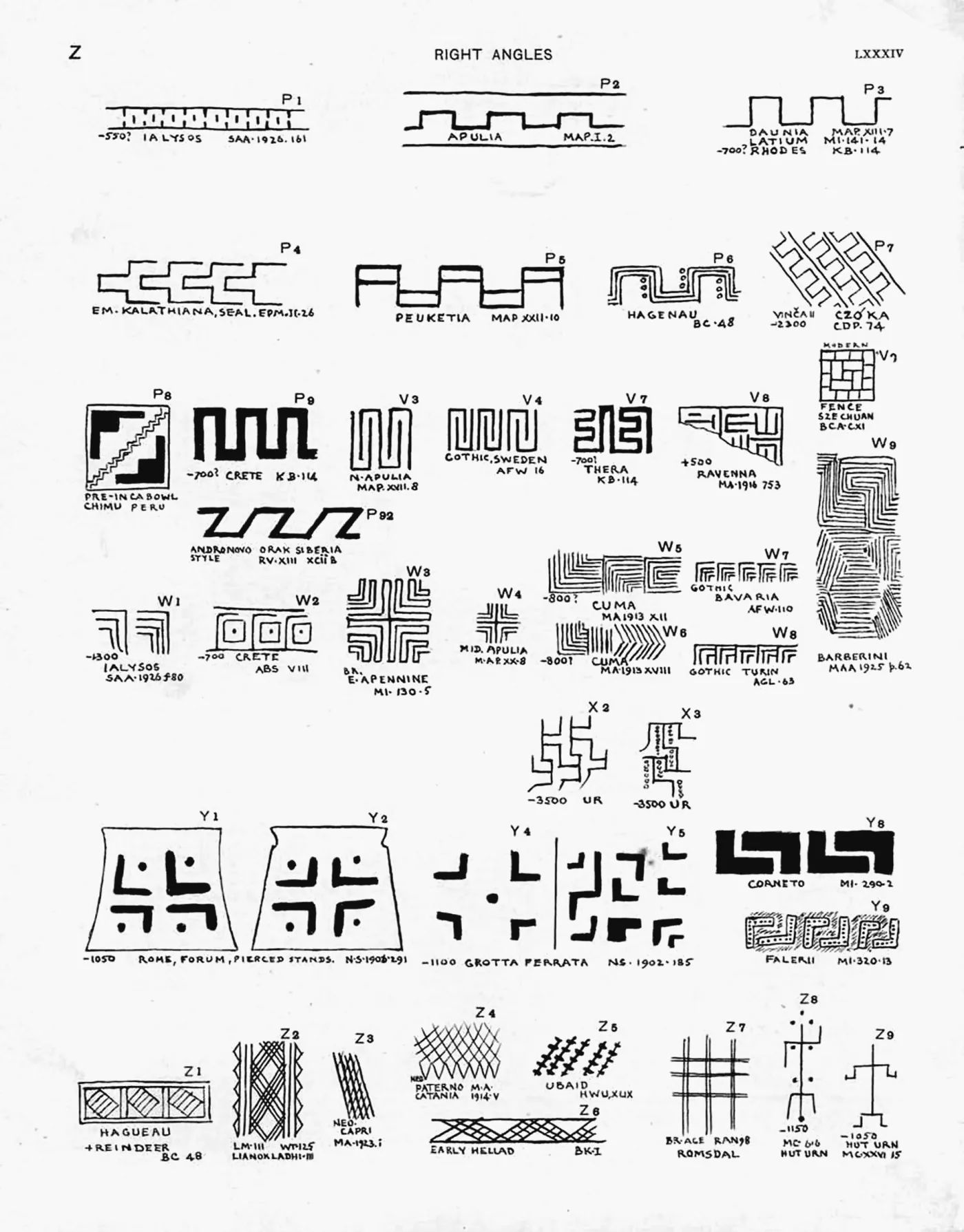
No note here. This is class Z reduced to its bare element: a line that turns at a right angle, and nothing else. Square turns (ZP), simple key lines (ZV), parallel squares (ZW), fret lines (ZX), L-shaped groups (ZY) and crossed lines (ZZ).

The sources range very wide: Ur at -3500, Vinča, Ialysos, a pre-Inca bowl from Chimu in Peru, Andronovo work from Siberia, a modern fence in Szechuan, and a Bronze Age grid from Romsdal.

he put a modern chinese fence in a catalogue of the ancient world and offered no explanation.
Plate LXXXV — Emblems Zoom
Plate LXXXV

Emblems

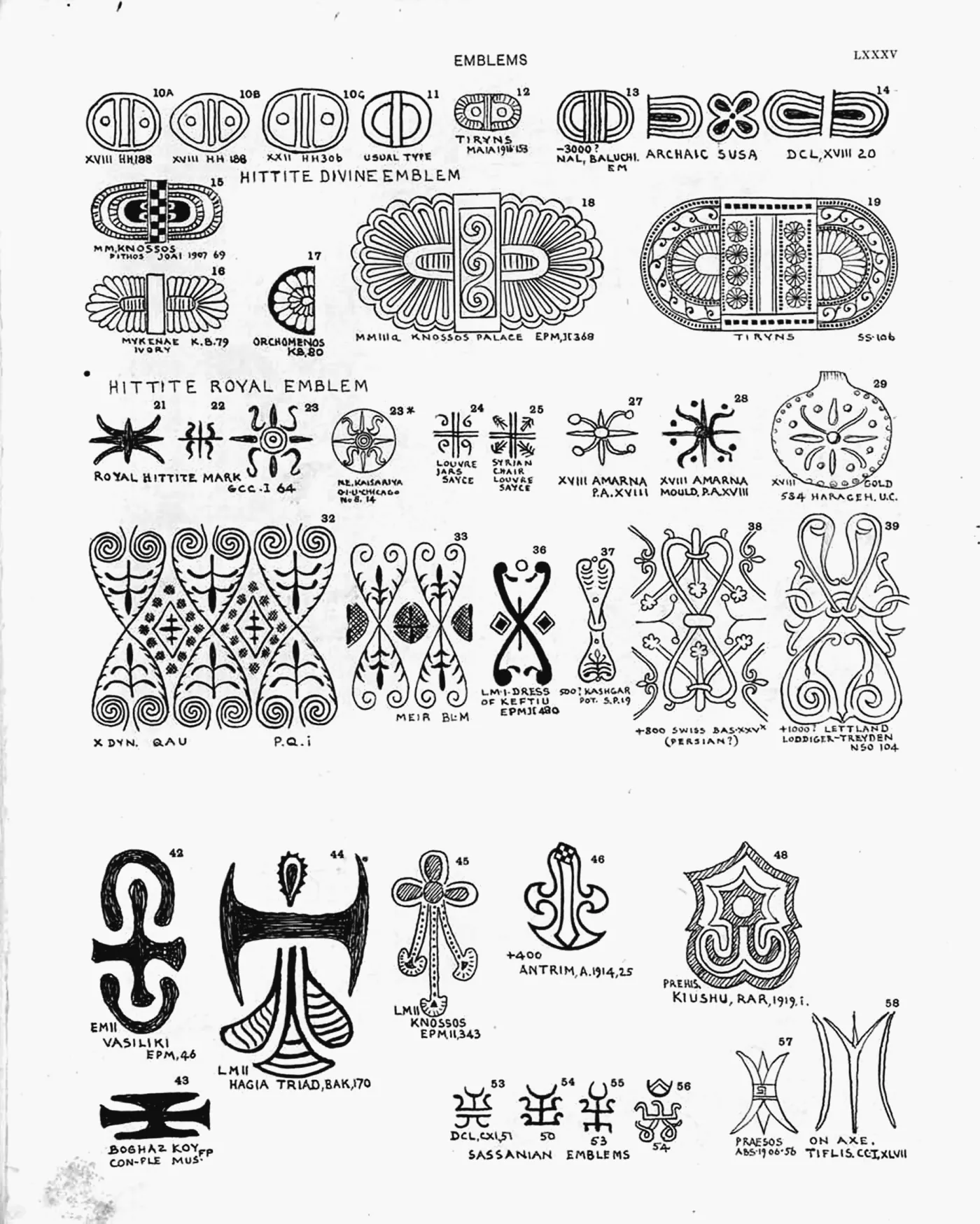
The sign above the heads of Hittite deities, 10 A, B, C and 11, is recognised as the mark of divinity; Petrie suggests a double shrine of the Mother and Son deities. A modification, 12, sits under five divine figures on a gold ring from Tiryns, and develops into 15 at Knossos, then 16, 18 and 19, which still keeps the double bar. Whether the Cretans knew its sense is "quite unknown".

The Hittite royal mark, 21-2-3, appears at Amarna as an amulet, 27, and as its mould, 28.

the mould is the giveaway: he reads it as egyptians making hittite amulets for trade.
Plate LXXXVI — Waves, Blobs, Oriental Zoom
Plate LXXXVI

Waves, Blobs, Oriental

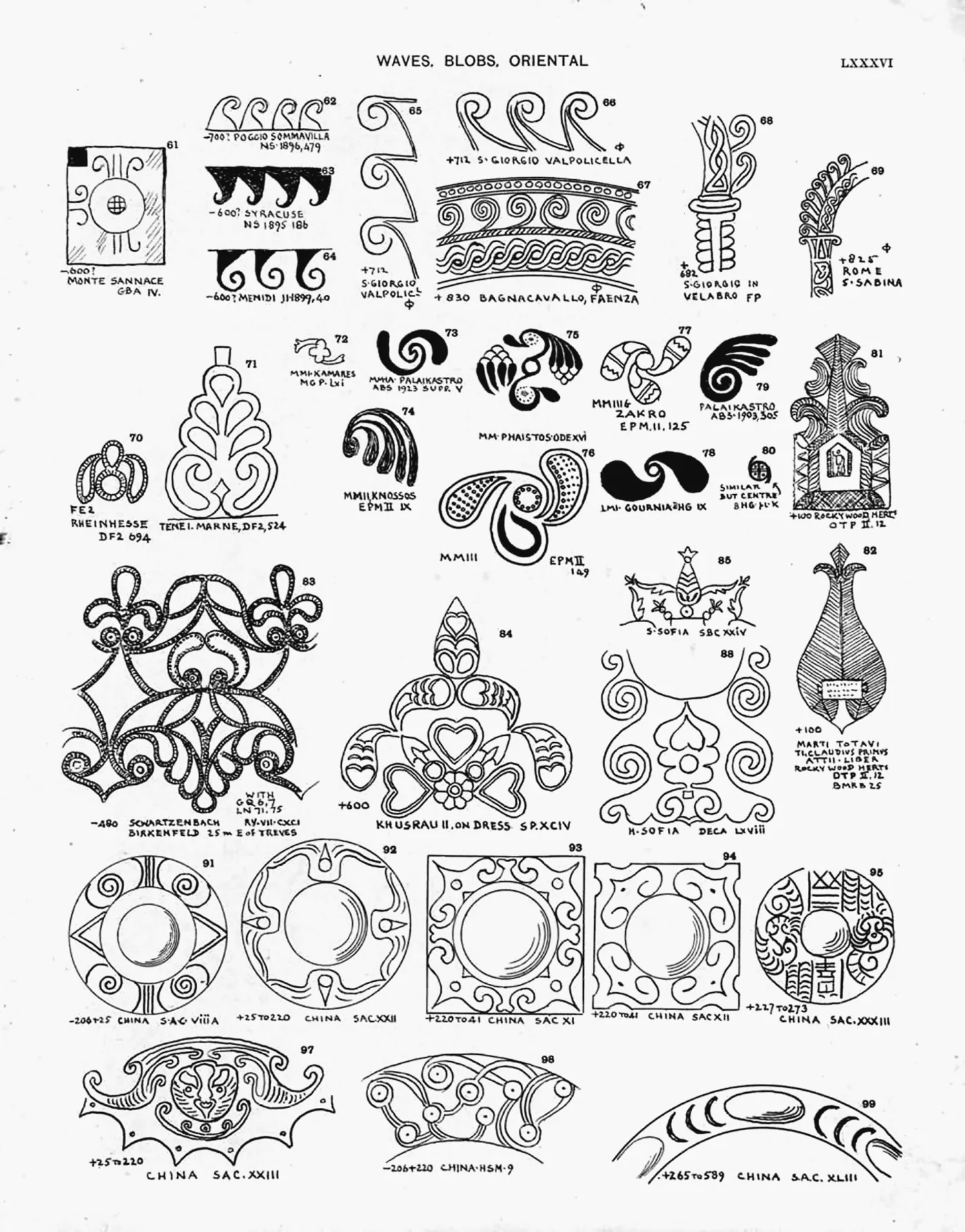
The wave group, 61-69, links to the spiral class but could not all be filed there. The "strange divergent droops", 70 to 79, Petrie cannot explain; but 83, from Schwartzenbach near Treves, has a flower at the top, droops at each side and two commas below — all, he says, in the fashion of Persian work, as on the dress of Khusrau, 84.

His explanation is offered as a question: a stray party from Xerxes' expedition of 480 B.C., lost in Thrace and pushing west to the Rhine.

he floats the lost persian war party as a question rather than an answer, and prints it anyway.
Plate LXXXVII — Scottish Shield and Broken Spear Zoom
Plate LXXXVII

Scottish Shield and Broken Spear

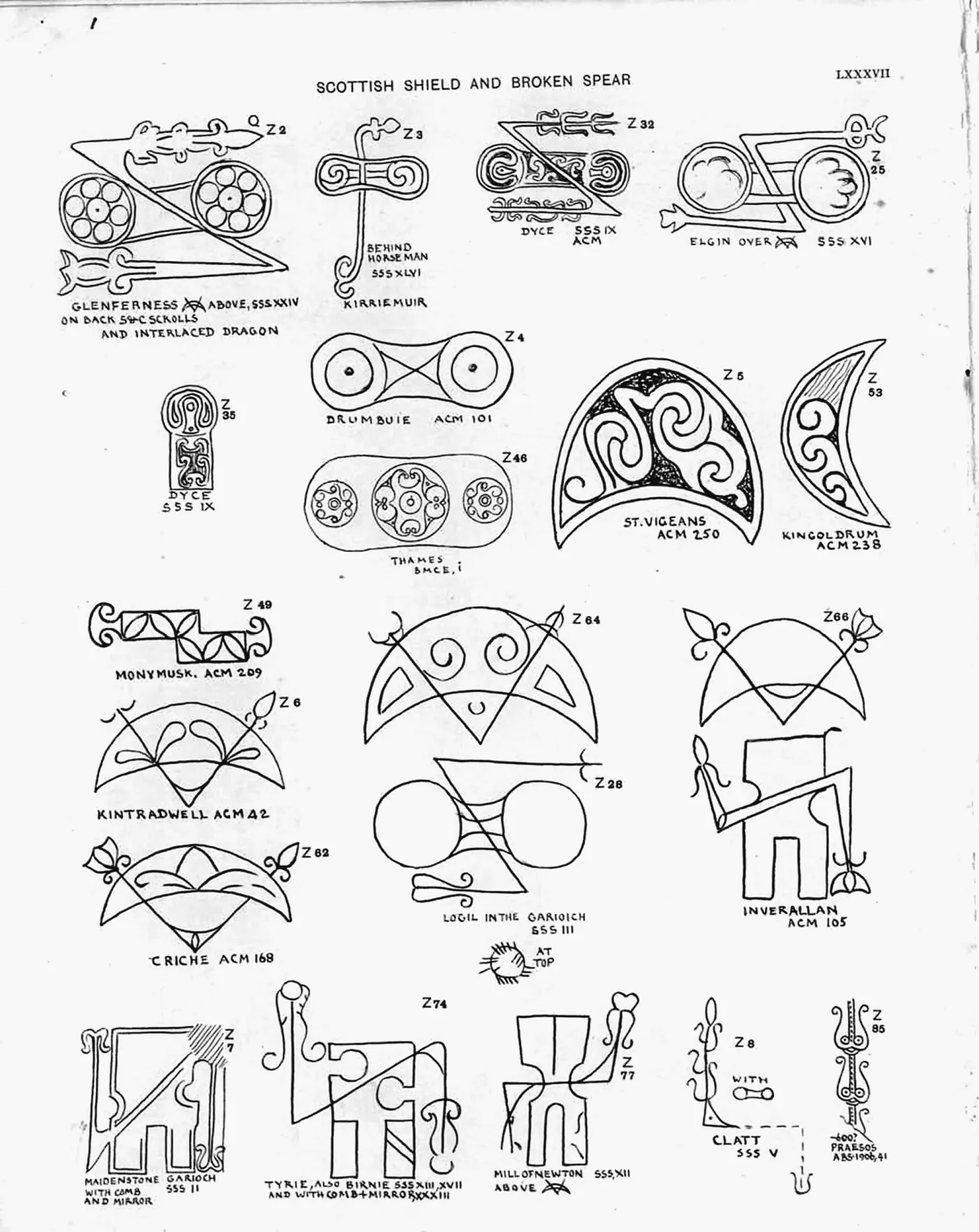
These Scottish tombstone signs had been read as a brooch and pin. Petrie rejects that — no pin widens at both ends, or bends. He sees a shield reversed and a warrior's spear broken, "like the heralds breaking their wands at a funeral", as symbols of the end of a career. The long round-ended form matches the Celtic shield from the Thames, QZ 46; the squared ones, QZ 66-77, he reads as a basket-work breastplate.

The origin being undiscussed elsewhere, he leaves the group in his miscellaneous class.

he also notes, without ceremony, that the animal on these stones — sometimes called an elephant — is probably a walrus.
Plate LXXXVIII — Odds Zoom
Plate LXXXVIII

Odds

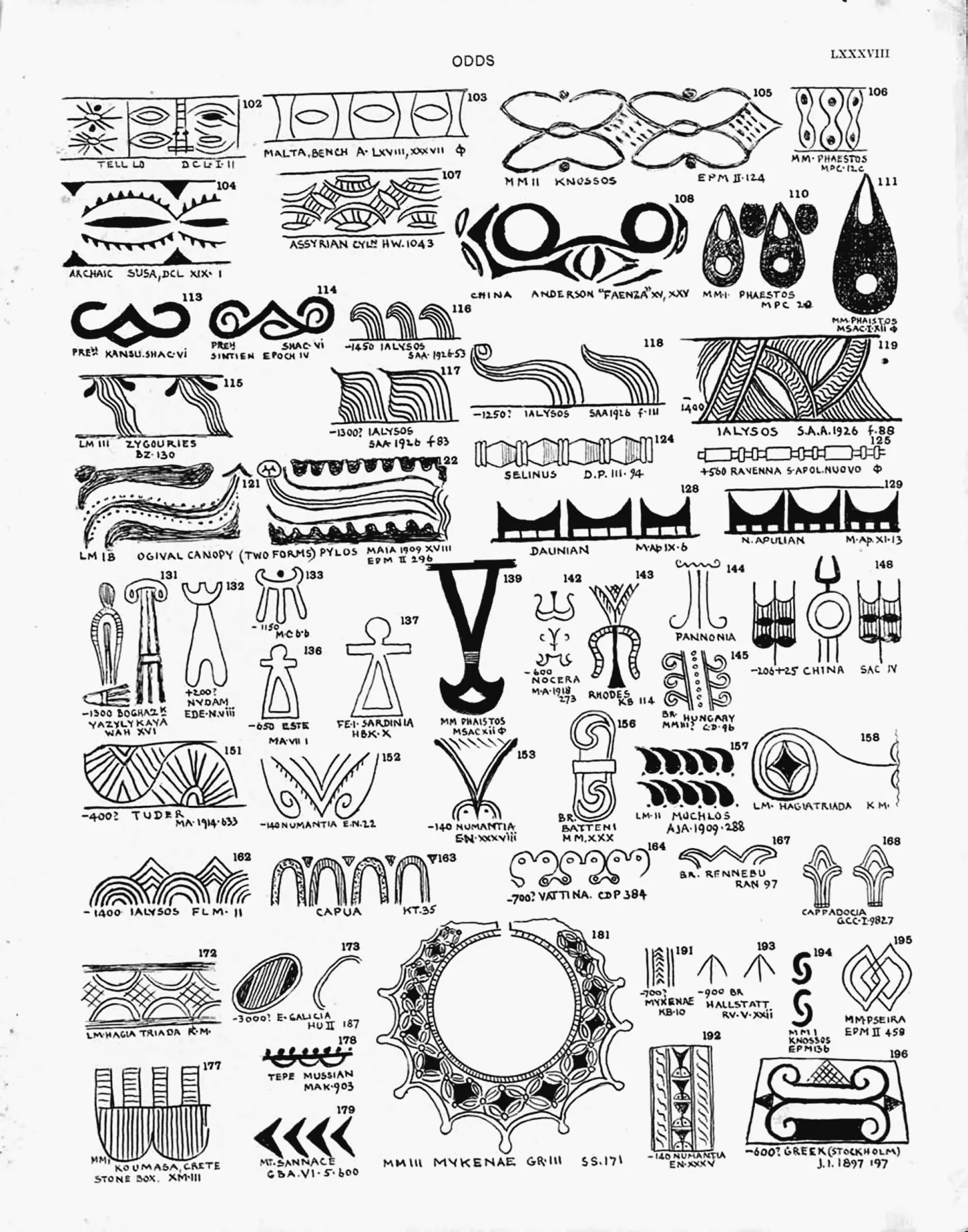
The last plate of the book, and Petrie's note on it is a single sentence: it "contains mysterious forms which may some day find a place in the series when we have much more material before us."

What that means in practice is a page of unfiled drawings numbered 102 to 196 — Maltese bench carving, Assyrian cylinder work, Cretan and Mykenaean scraps, Chinese pieces, hut-urn outlines, and a large beaded ring from Mykenae filling the middle of the bottom row.

eighty-eight plates in, the book closes on a shrug and a promise to keep looking.