Decorative Patterns
Classes D–G · Plates IX–XXIV

Lotus, Lily & Arabesque

Sixteen plates following the lotus out of Egypt, the lily into Crete, and both of them into every border in the Mediterranean.

Plate IX — Naturalistic Plants Zoom
Plate IX · Class D

Naturalistic Plants

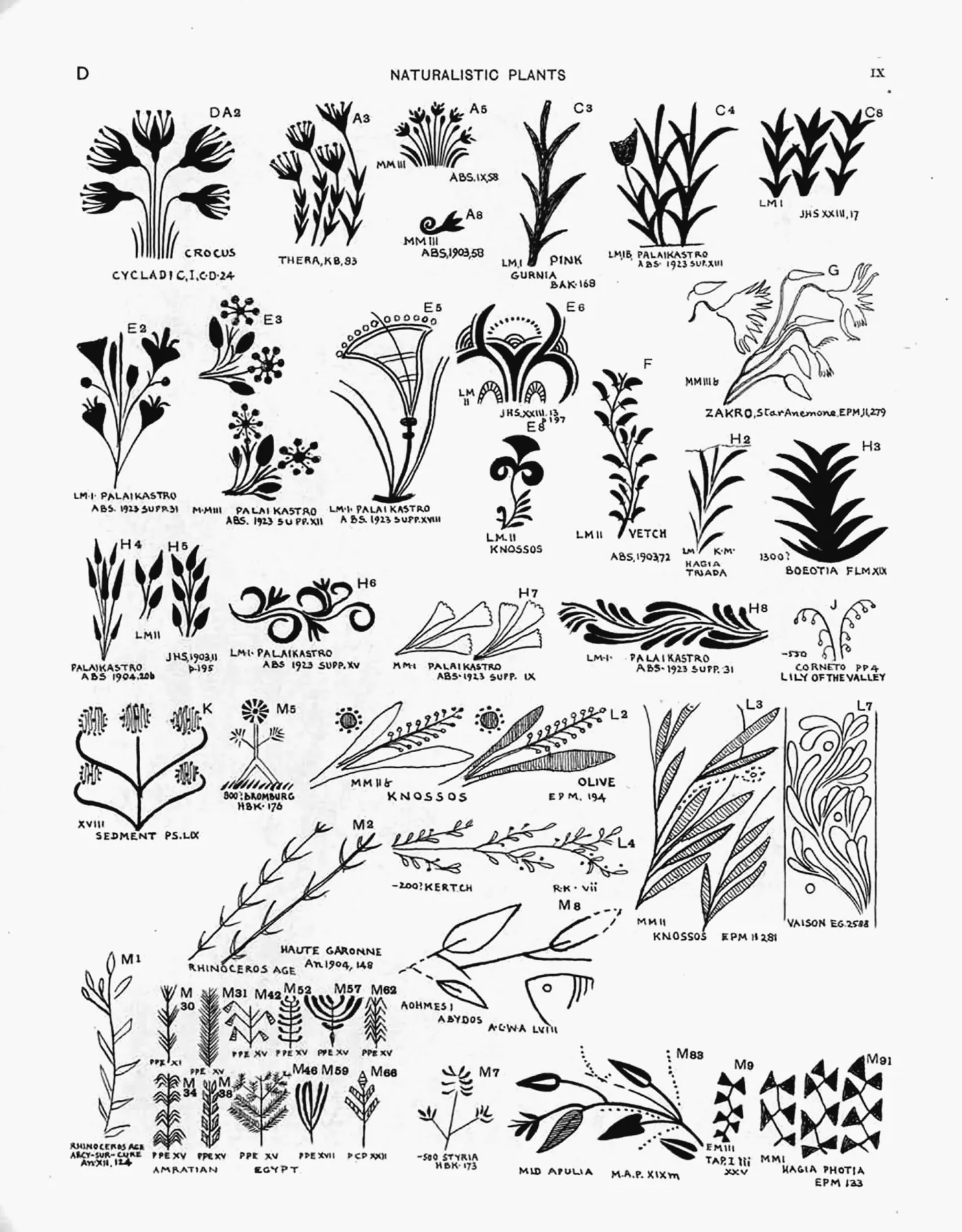
Petrie opens the plant classes with a claim about origins: plant forms are the earliest types of decoration we have, appearing in France, DM 1, 2, and in Egypt, DM 30-66, at the very beginning of prehistoric art.

He then turns it into an argument. Since nobody would suppose magic powers gained from this scatter of species, they warn us against reading magic intent into the animal designs either — the taste for beauty will produce one as well as the other.
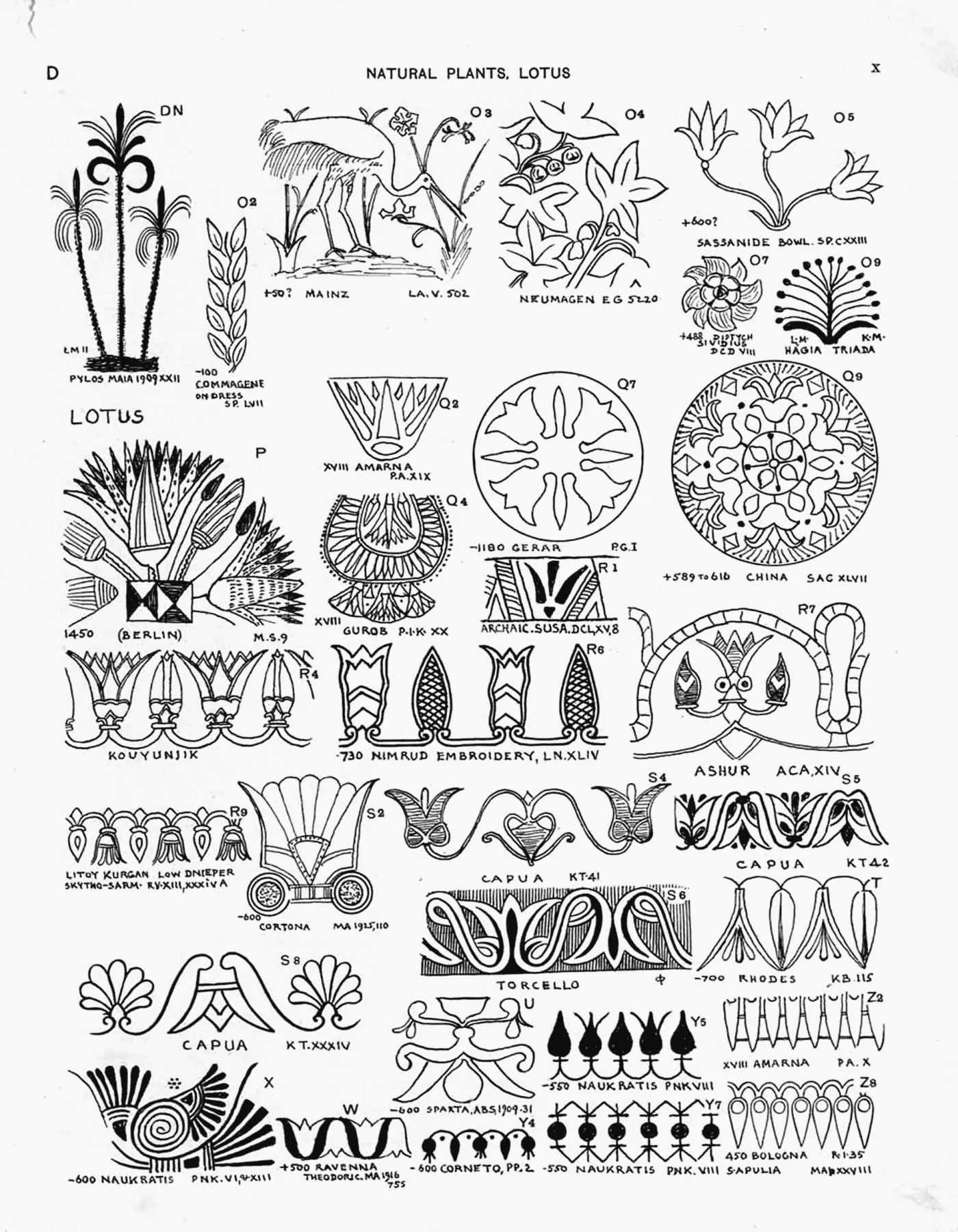
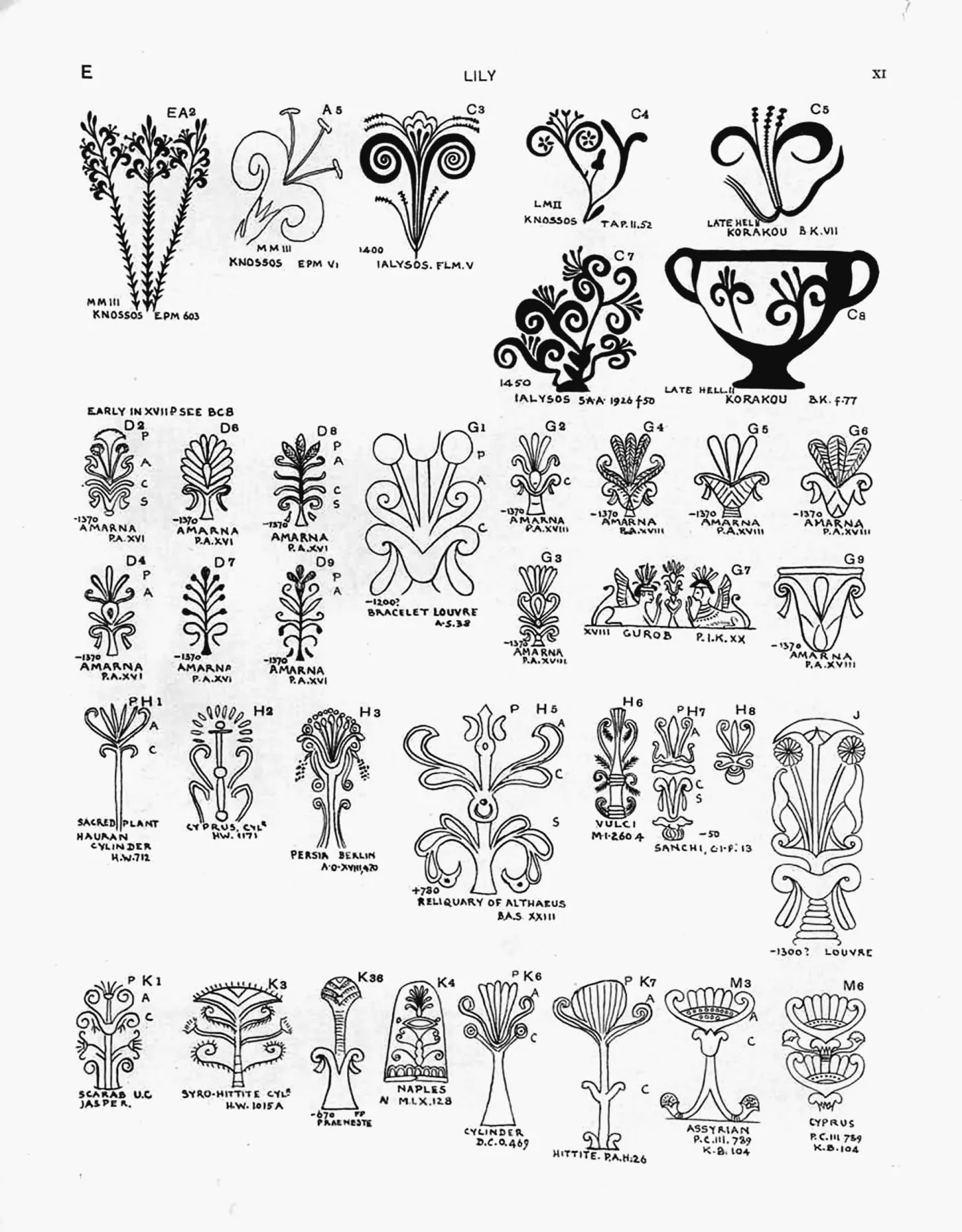
Plate X — Natural Plants, Lotus Zoom
Plate X · Class D

Natural Plants, Lotus

Petrie's verdict on the lotus is that Egypt, where it actually grew, did least with it: the flower was "but little varied" there. The spread came instead from the Assyrian form, the Kouyunjik border DR 4, and from that it entered Cyprus and the West, and passed north into Scythia, DR 9 — the piece from the Litoy Kurgan on the lower Dnieper.

Plate XI — Lily Zoom
Plate XI · Class E

Lily

The lily was adopted in Crete about -2000, EA 2, 5, formalised by -1400, EC 3, and finally "lost to nature," EC 7. In Syria it took a different course, and at Amarna in -1370 it was set out as a botanical exposition.

Those Amarna drawings are lettered on the plate itself: P for the pistils, A for the anthers, C for the calyx, S for the spathe with its withered tip. The distinctions survived in later borrowings, down to the Hittite form, EK 7.

for once the letters beside the drawings are anatomy rather than provenance.
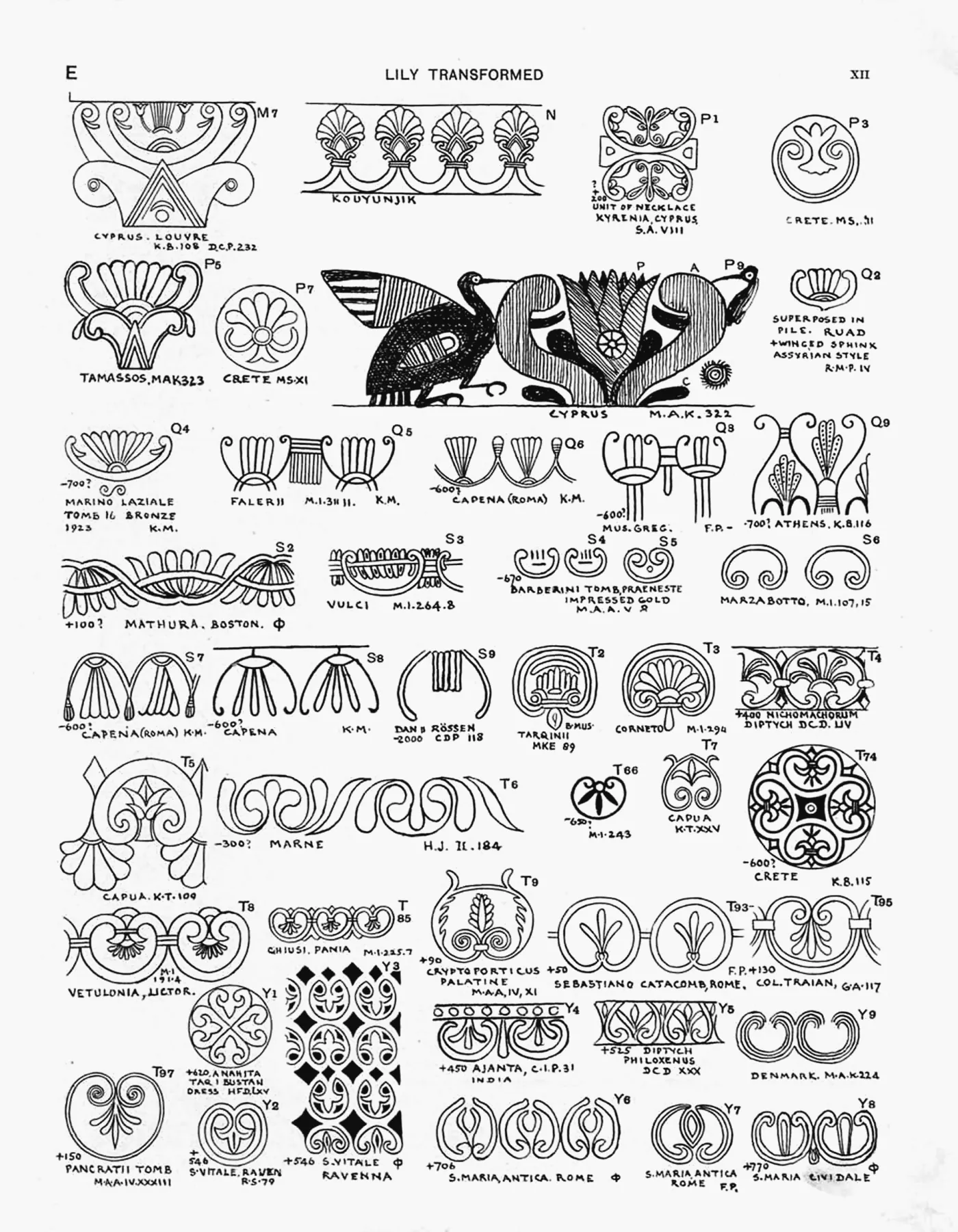
Plate XII — Lily Transformed Zoom
Plate XII · Class E

Lily Transformed

The second half of Petrie's lily sequence. The Assyrians, who "did not understand it," formalised the flower into what he calls the bowl type, EM 3. Western stages carried that to ES 4, 5, 6, and a third form grew out of it, ET 2, 3.

From there it ran through a thousand years of classical varieties before disappearing as EY 7, 8, 9. He gives a fuller account in Ancient Egypt, 1929, p. 65.

by the bottom row the flower has passed through so many hands it is more of a rumour than a lily.
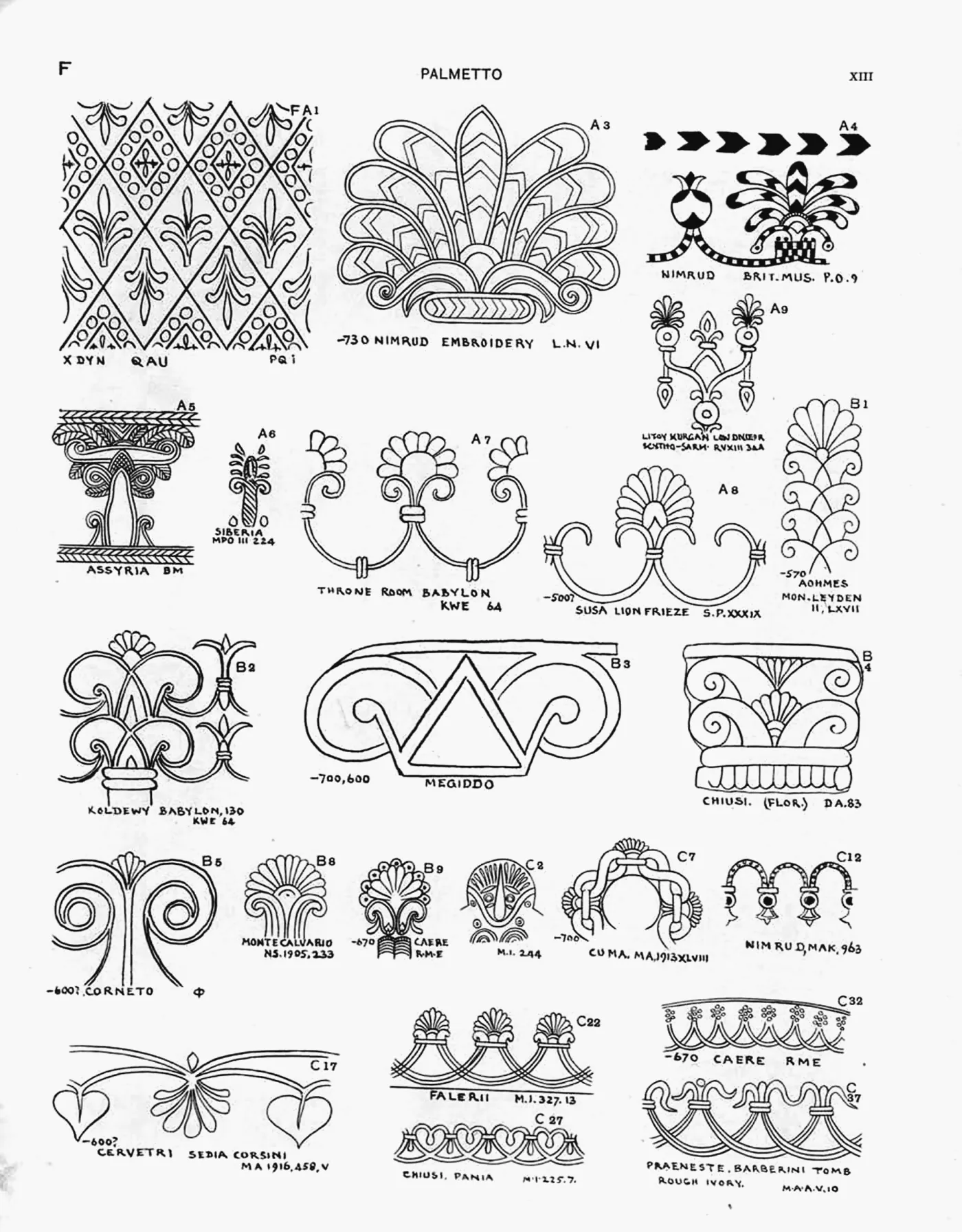
Plate XIII — Palmetto Zoom
Plate XIII · Class F

Palmetto

Petrie dates the palmetto's arrival in Egypt to 2800 B.C., FA 1, referring the reader also to Emblems 20, pl. LXXXV. Assyria then developed it greatly, inserting it into volute capitals, FB 2, 4, 5, 6, and adapting it to running borders, FC.

The Greek types are compounds: the acanthus leaf, FD, combined with a lotus standing on a degraded form of the lily, FD 5 — "three subjects in one."

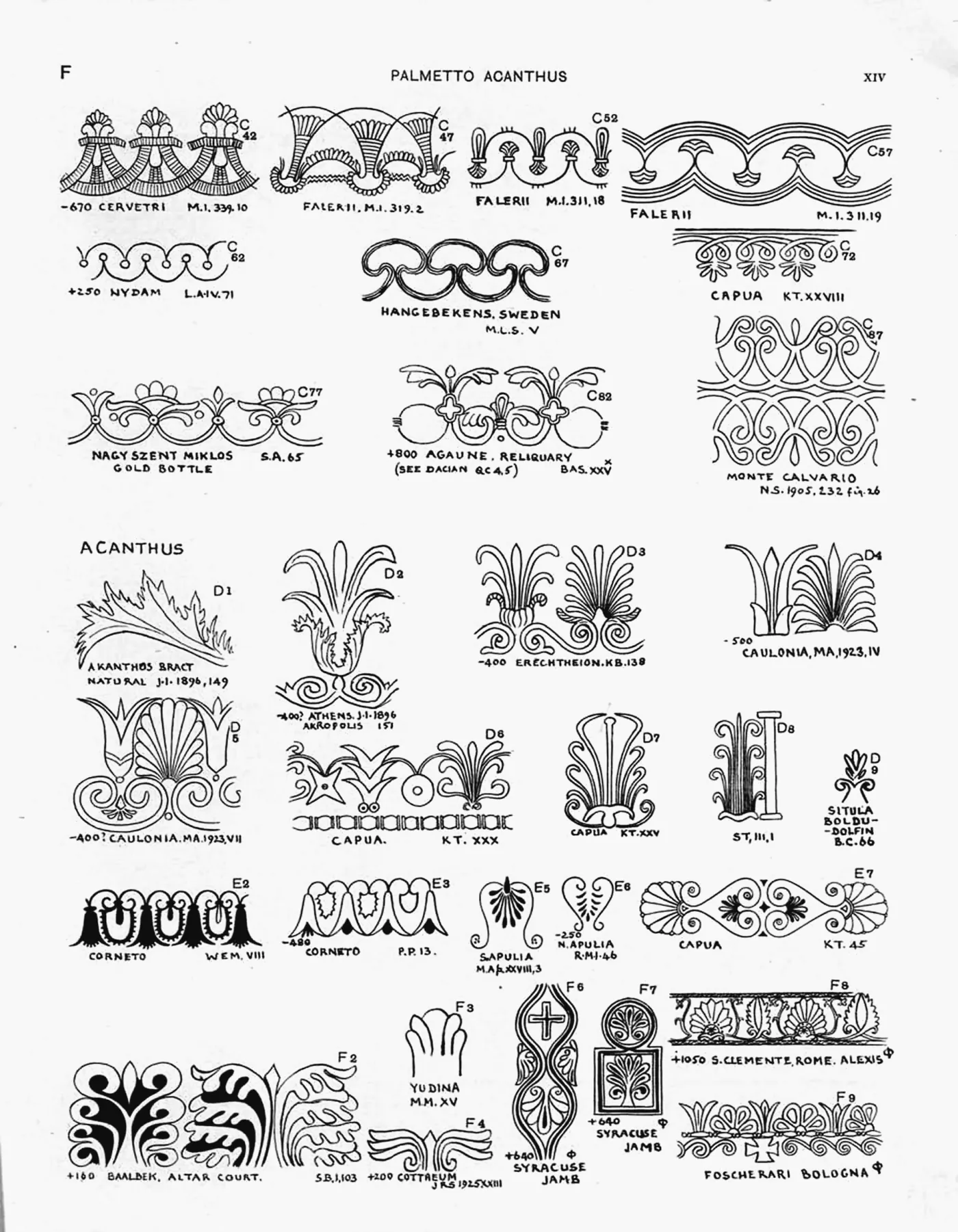
Plate XIV — Palmetto Acanthus Zoom
Plate XIV · Class F

Palmetto Acanthus

No note from Petrie for this plate. The upper half continues the palmetto running borders of class F, family C, in linked arches and interlocking scrolls, running from Etruscan Cerveteri and Falerii out to Nydam, a Swedish find, and the Nagyszent Miklos gold bottle.

Below, under the hand-lettered heading Acanthus, the leaf is followed from a natural bract through Greek and South Italian capitals to acanthus borders and the debased late forms on Italian church stonework.

the acanthus section opens with a real bract drawn from life, as a control specimen for everything after it.
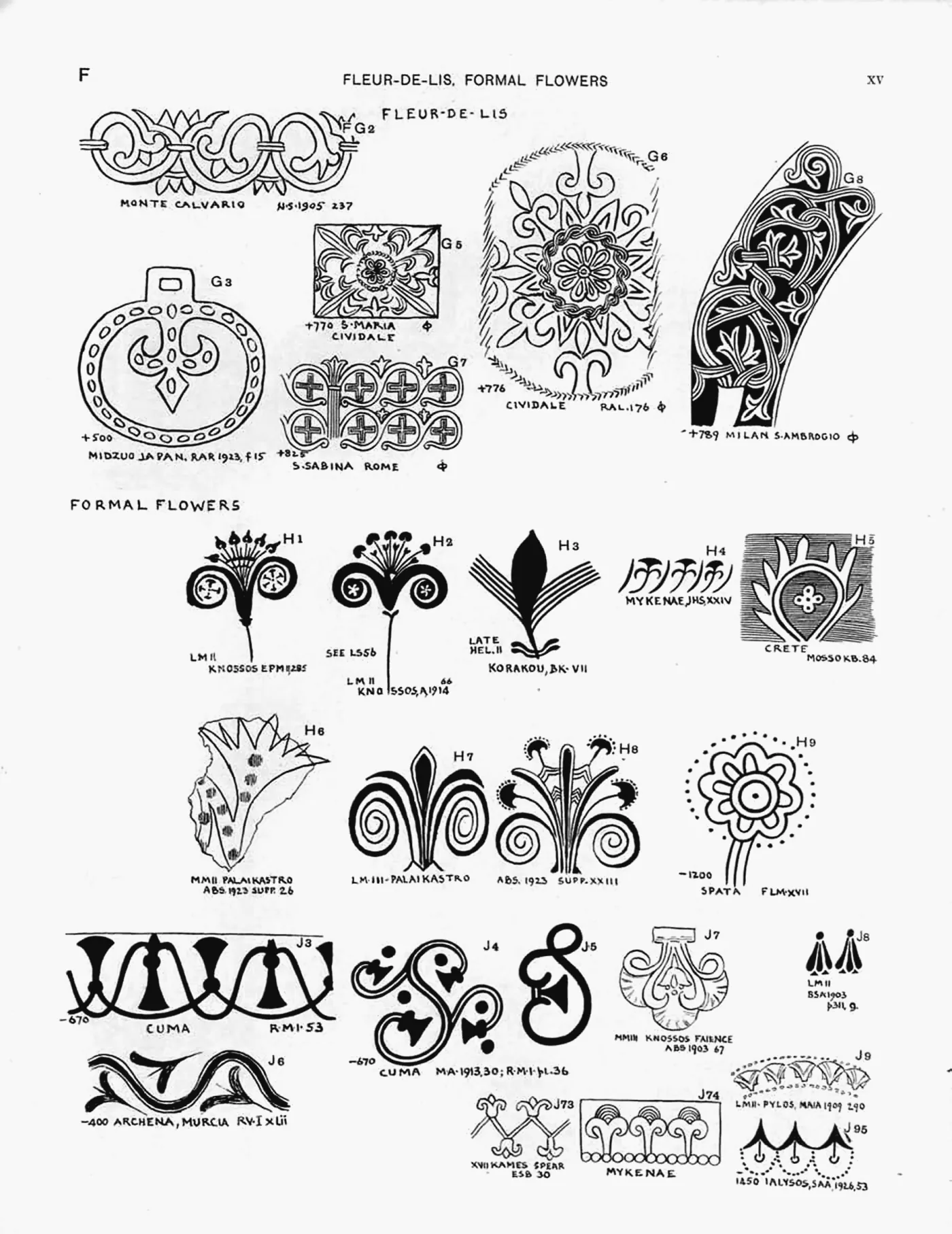
Plate XV — Fleur-de-lis, Formal Flowers Zoom
Plate XV · Class F

Fleur-de-lis, Formal Flowers

Petrie notes the fleur-de-lis in Japan, FG 3, almost as early as among the Franks. It did not enter Italian decoration until the Papal alliance with the Franks against the Lombards in +776, and probably left architecture again after Charlemagne.

The lower half turns to formal flowers, where the lily with curled and spiral petals, FH 1, 2, matters for dating: he places the form at 1500 B.C., when it was carried on the way to Britain.

the fleur-de-lis shows up in japan at about the same date as among the franks. petrie records it and offers no explanation.
Plate XVI — Formal Flowers Zoom
Plate XVI · Class F

Formal Flowers

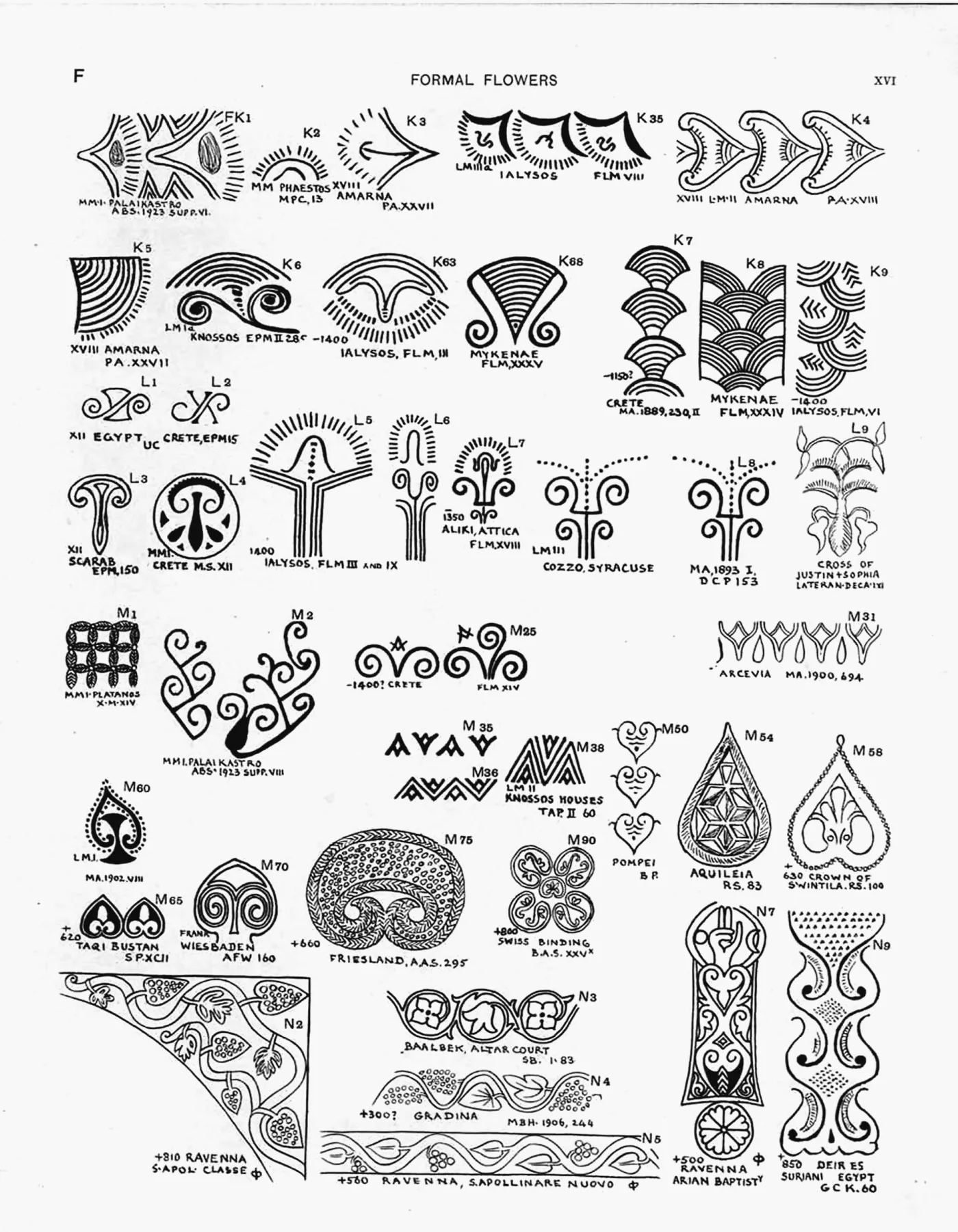
No note from Petrie. The plate carries class F's formal flowers through three families. Radiate flowers, FK, open with Cretan and Amarna fan forms; stem flowers, FL, are small curling calyxes on stalks, Aegean and Sicilian; geometric flowers, FM, reduce the blossom to hearts, teardrops and lattices on Frankish, Gothic and Frisian metalwork.

The last rows leave flowers for leafy vine borders, FN, on Ravenna and Baalbek church work.

somewhere between the crocus of plate ix and the lattices here, a flower quietly stops being a flower.
Plate XVII — Ivy Zoom
Plate XVII · Class F

Ivy

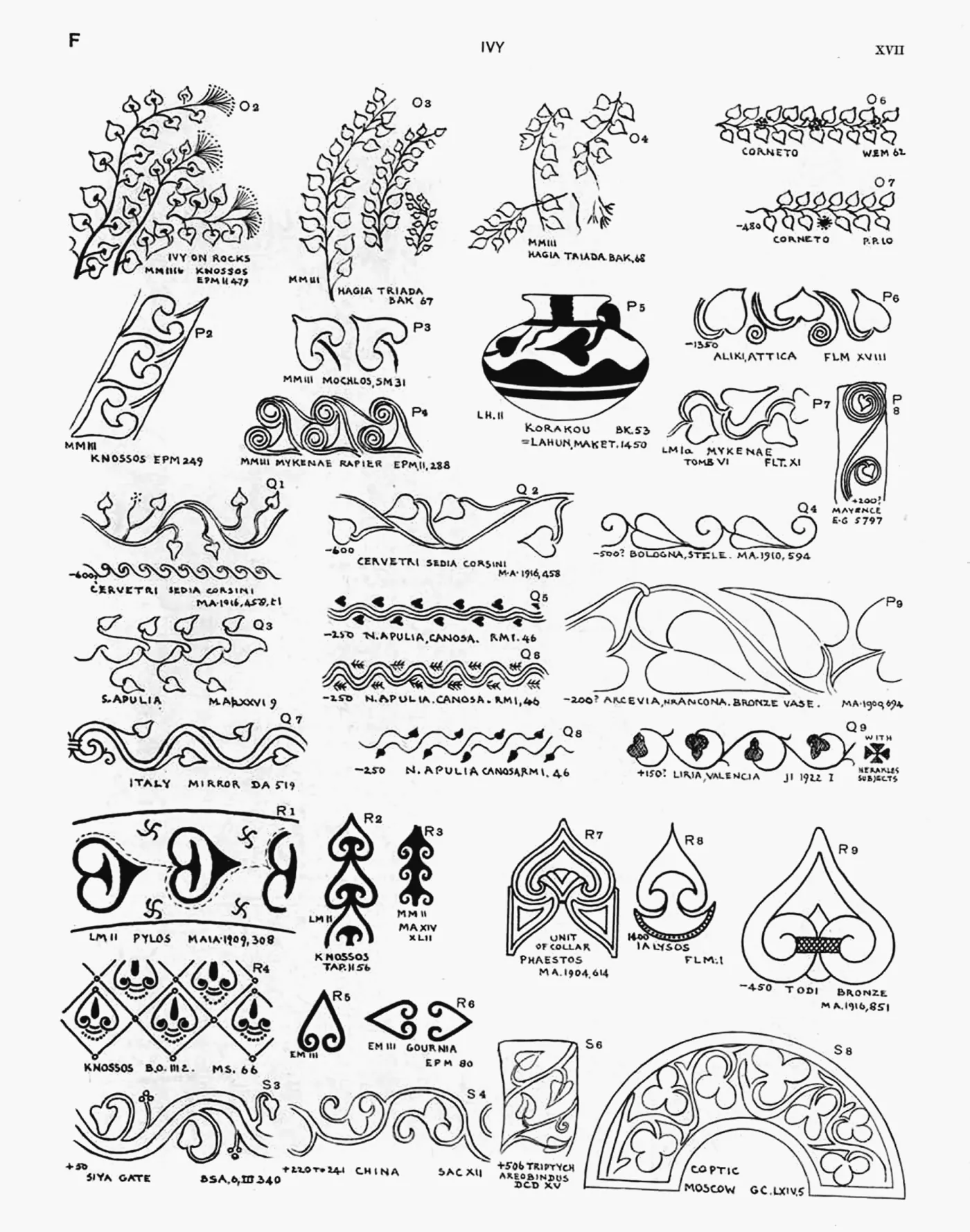
No note from Petrie. A whole plate for ivy, class F, in five families. It begins naturalistically, FO, with sprays drawn on rocks at Knossos and from Hagia Triada, then large-leaved forms, FP, and running ivy borders, FQ, mostly Etruscan and South Italian.

The lower half formalises the leaf, FR, into hearts and spades on Cretan and bronze work, and closes with Oriental and Coptic versions, FS, from Syria, China and Egypt.

an entire plate of ivy and not one word of comment.
Plate XVIII — Foliage Zoom
Plate XVIII · Class F

Foliage

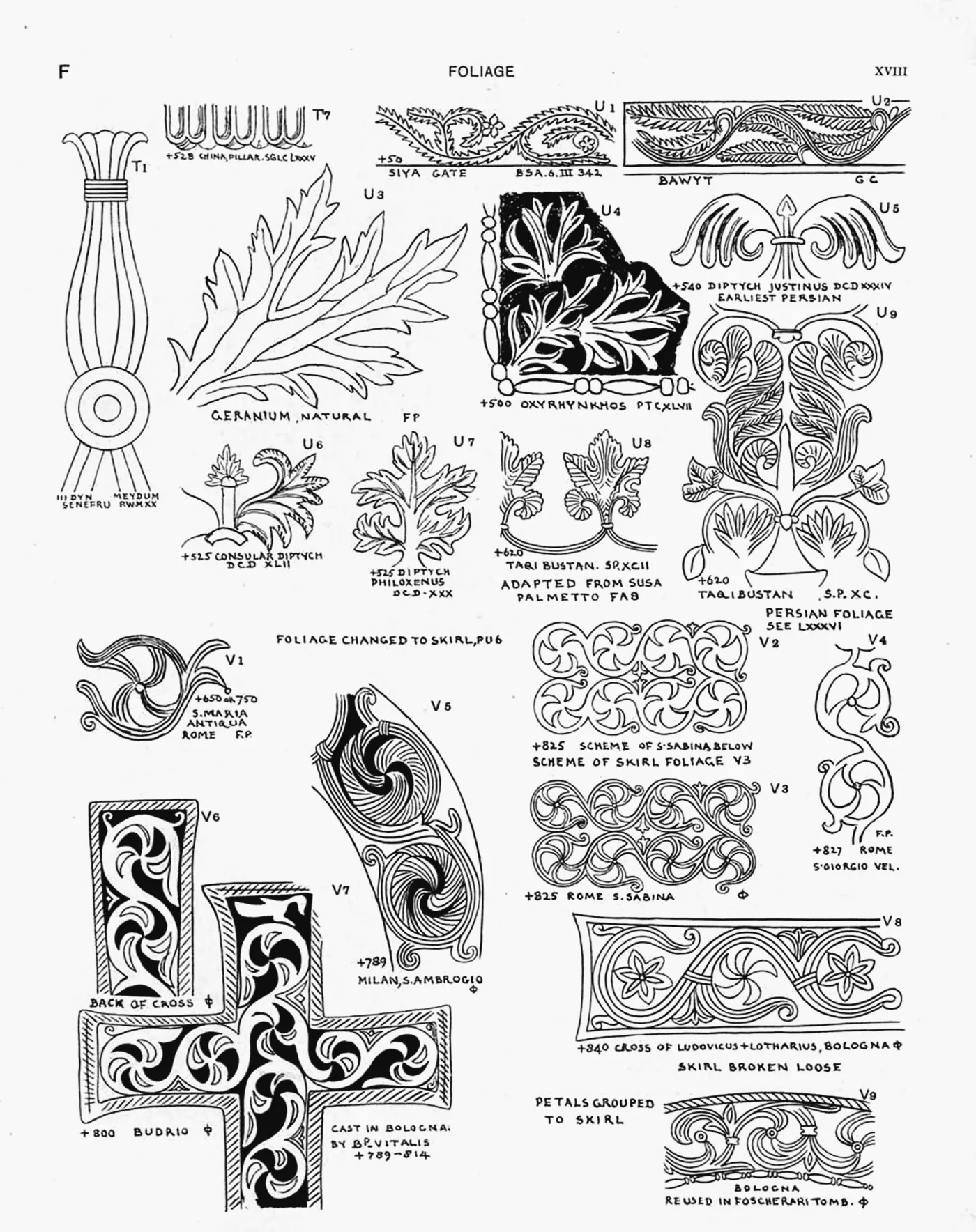
Petrie tracks two changes here. First the plant itself: the foliage forms "seem to pass from acanthus to wild geranium" in FU 3, 4 — and the natural geranium leaf is drawn on the plate for comparison.

Second, the foliage starts to spin. The development at +800, FV 6, 7, was already growing into a skirl by +750, FV 1, and +825, FV 3, and by +840 the whorls had come loose from the branch entirely, FV 8.

the plate labels its own climax in block capitals: skirl broken loose.
Plate XIX — Arabesques Zoom
Plate XIX · Class G

Arabesques

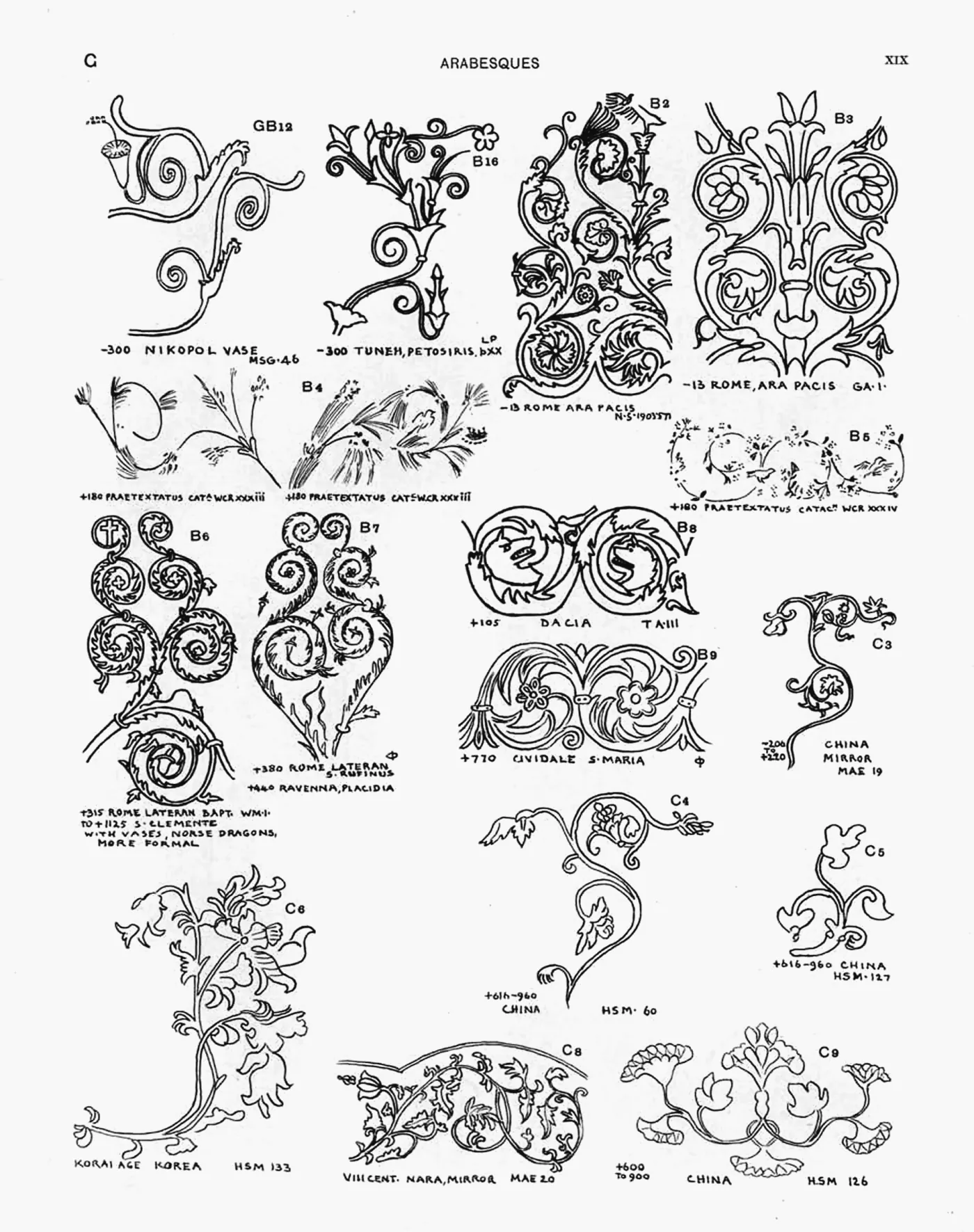
Arabesques start at -300, Petrie says, with a bract developing at the fork of a branch, GB 12, which grows into a calix form, GB 16, 2. The loose, sketchy sprays from the Praetextatus catacomb of +180, GB 4, 5, he calls "a real reversion to Nature, unique in such work."

After that the arabesque standardised, and served for all apse mosaics of the IV to XII centuries. He suspects the Dacian form of +105 started the Chinese Han type, GC 3 to 8.

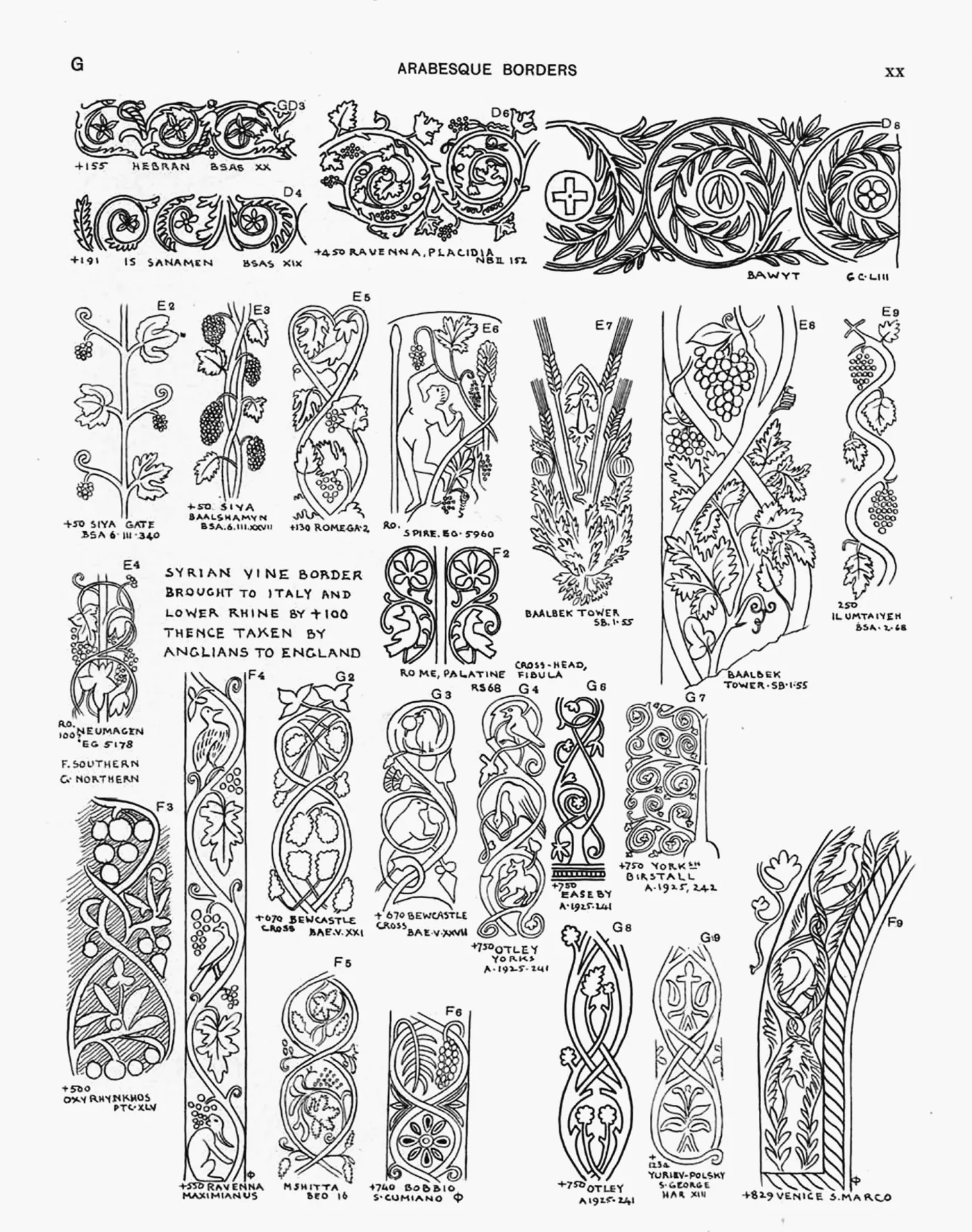
Plate XX — Arabesque Borders Zoom
Plate XX · Class G

Arabesque Borders

Petrie's route map for the vine. The Syrian vine border, GE 2, 3, grew into the fine school of the second century, GE 7, 8; Rome took it up, GE 5, by A.D. 130, and it passed to the Lower Rhine, GE 4, 6. Naturalised there, the Anglian invasion carried it into England, where it appears on the Northumbrian crosses, GG 2, 3, 4.

His conclusion: with the design already in use on the Lower Rhine, "there is no need to look to Syrian monks."

petrie wrote the conclusion straight onto the plate in block capitals, which is one way to close an argument.
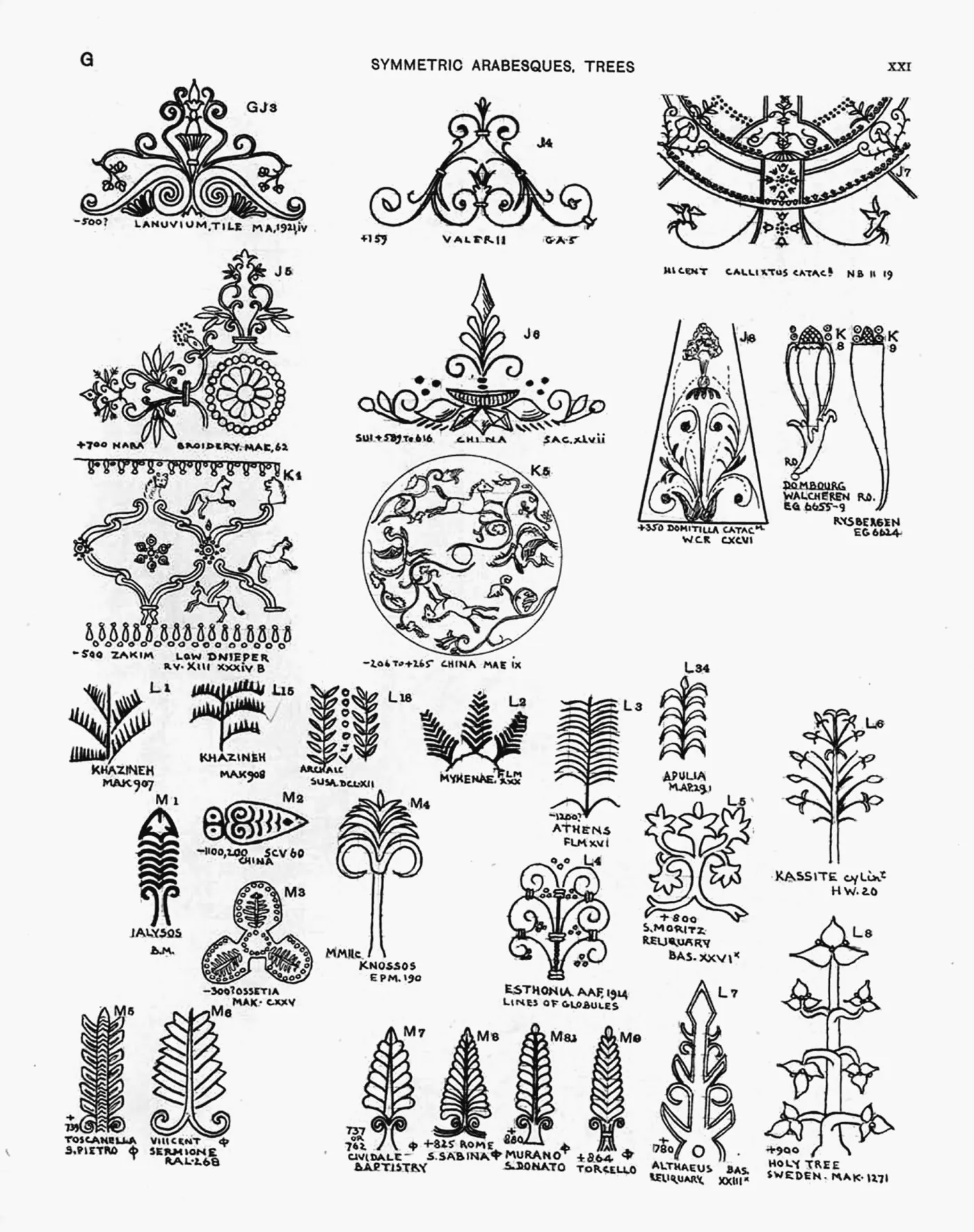
Plate XXI — Symmetric Arabesques, Trees Zoom
Plate XXI · Class G

Symmetric Arabesques, Trees

Petrie reads the symmetric arabesques as evidence of traffic eastward. The formal plant design, GJ 3, 4, is translated to Persia, GJ 5, and to China, GJ 6, probably through Roman influence.

But the Han style, GK 5, he judges must come from earlier Assyro-Persian influence, on the pattern of GK 4, which entered Russia. The lower two-thirds of the plate leaves arabesques behind for trees.

the tree half reads like a nursery catalogue, running from kassite cylinder seals to a swedish holy tree of +900.
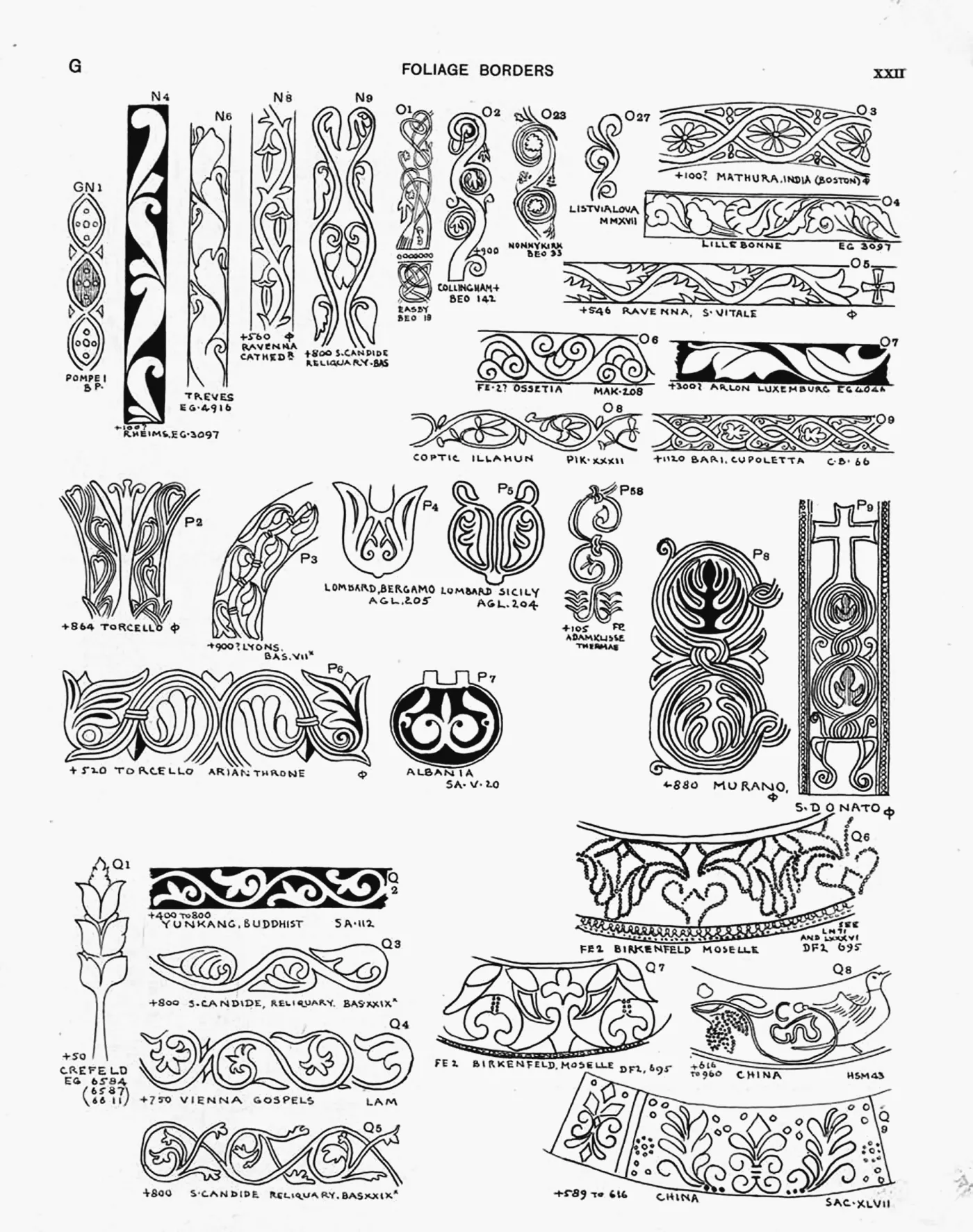
Plate XXII — Foliage Borders Zoom
Plate XXII · Class G

Foliage Borders

Petrie's only comment on this plate is a cross-reference: for the Persian affinity of the Moselle work, GQ 6, he sends the reader to pl. LXXXVI and its notes. The piece in question is the beaded, drooping foliage from Birkenfeld on the Moselle near the foot of the page, and the plate itself carries the same referral in the caption.

The rest is left to speak for itself: Italian, Northern, late and Northern foliage borders, four families in all.

one plate, one note, and the note is a forwarding address.
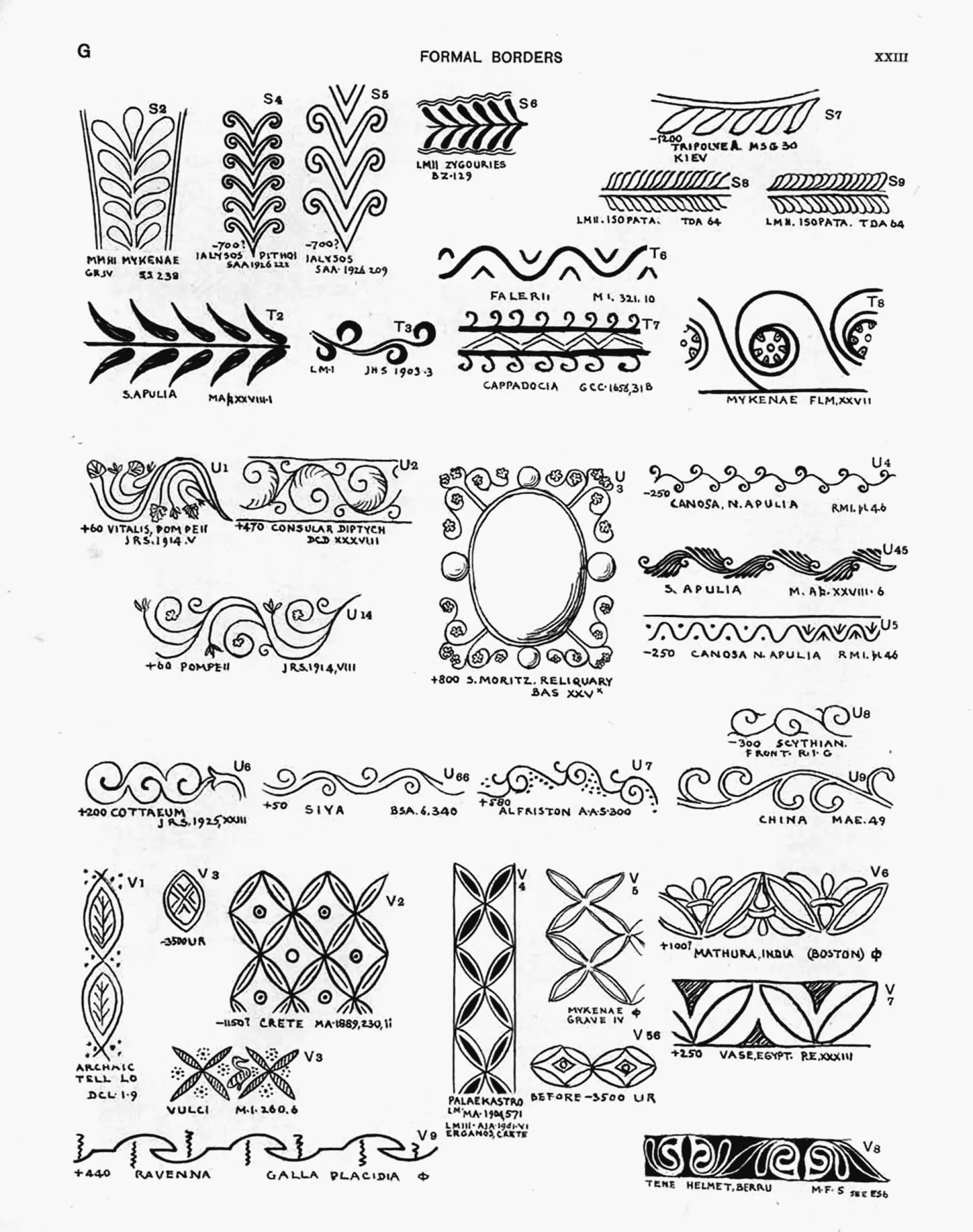
Plate XXIII — Formal Borders Zoom
Plate XXIII · Class G

Formal Borders

No note from Petrie. The plate collects formal borders in four families of class G: chevron and herringbone leaf bands, GS and GT, from Mykenae, Ialysos, Falerii and Cappadocia; running scroll borders, GU, largely Pompeian, Apulian and Scythian with a Chinese wave at the end; and leaf-and-lozenge forms, GV, which include some of the earliest material anywhere in the book.

two of these borders come from ur at or before -3500 and are still, structurally, just leaves in a row.
Plate XXIV — Formal Vegetation Zoom
Plate XXIV · Class G

Formal Vegetation

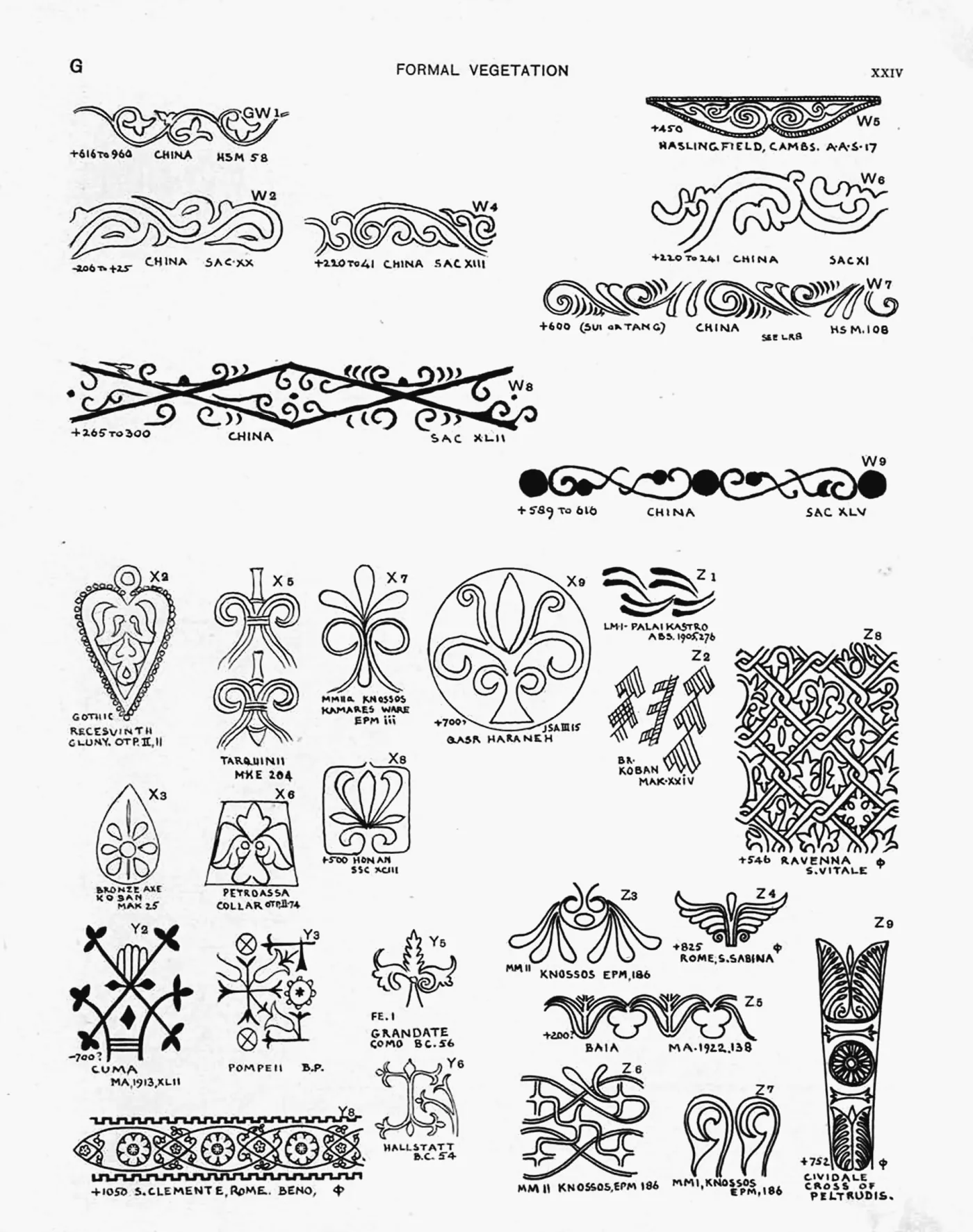
No note from Petrie, and this is the last plate of the arabesque class. The top half is almost entirely Chinese: running cloud-and-leaf borders, GW, dated between -206 and +960, with a single outlier from Haslingfield, Cambs, of +450.

The lower half gathers formal plants, GX, GY and GZ — heart-shaped and fleur-de-lis-like sprays on metalwork, pottery and stone from Knossos, Tarquinii, Petrossa, Cuma, Ravenna and Cividale.

class G signs off with eight chinese scroll borders and one from cambridgeshire.