Decorative Patterns
Classes M–N · Plates XLI–XLVIII

Twists, Plaits & Knotwork

Interlace from the two-strand twist up to the Norse dragon plait, with the chain, the guilloche, and one lonely plate of pentagons.

Plate XLI — Twist: Single Line, Double Zoom
Plate XLI · Class M

Twist: Single Line, Double

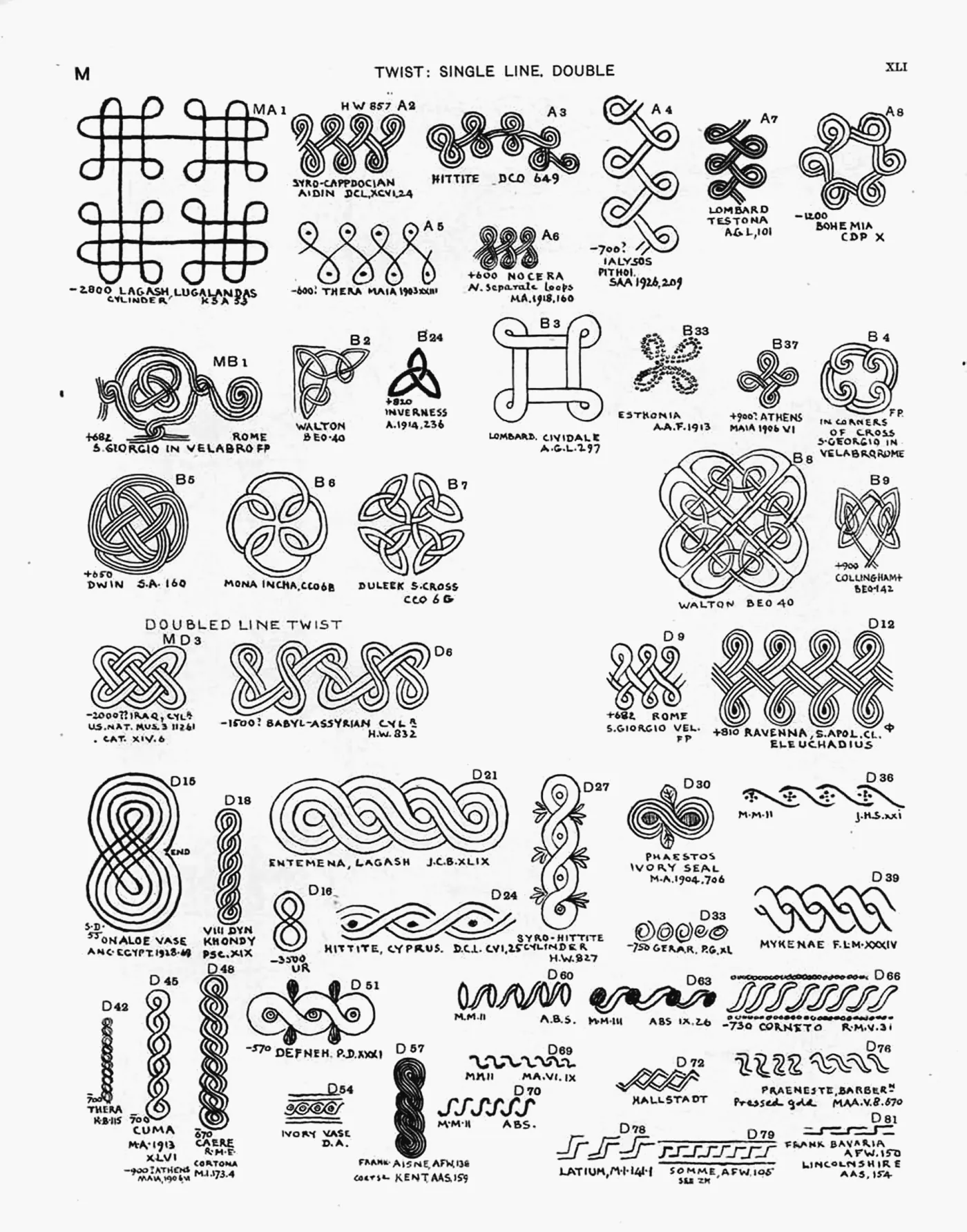
Class M opens the twist series. The MA family gathers single-line twists, from the -2800 Lagash cylinder's grid of interlocking loops through Hittite, Lombard and Bohemian versions; MB turns the same line into closed knots, three- and four-lobed roundels from Walton, Mona Incha and Duleek.

Under the printed heading Doubled Line Twist, the MD family redraws these in paired lines: guilloche waves, figure-of-eight coils, and at the foot a row where the twist flattens into plain zigzags and square waves.
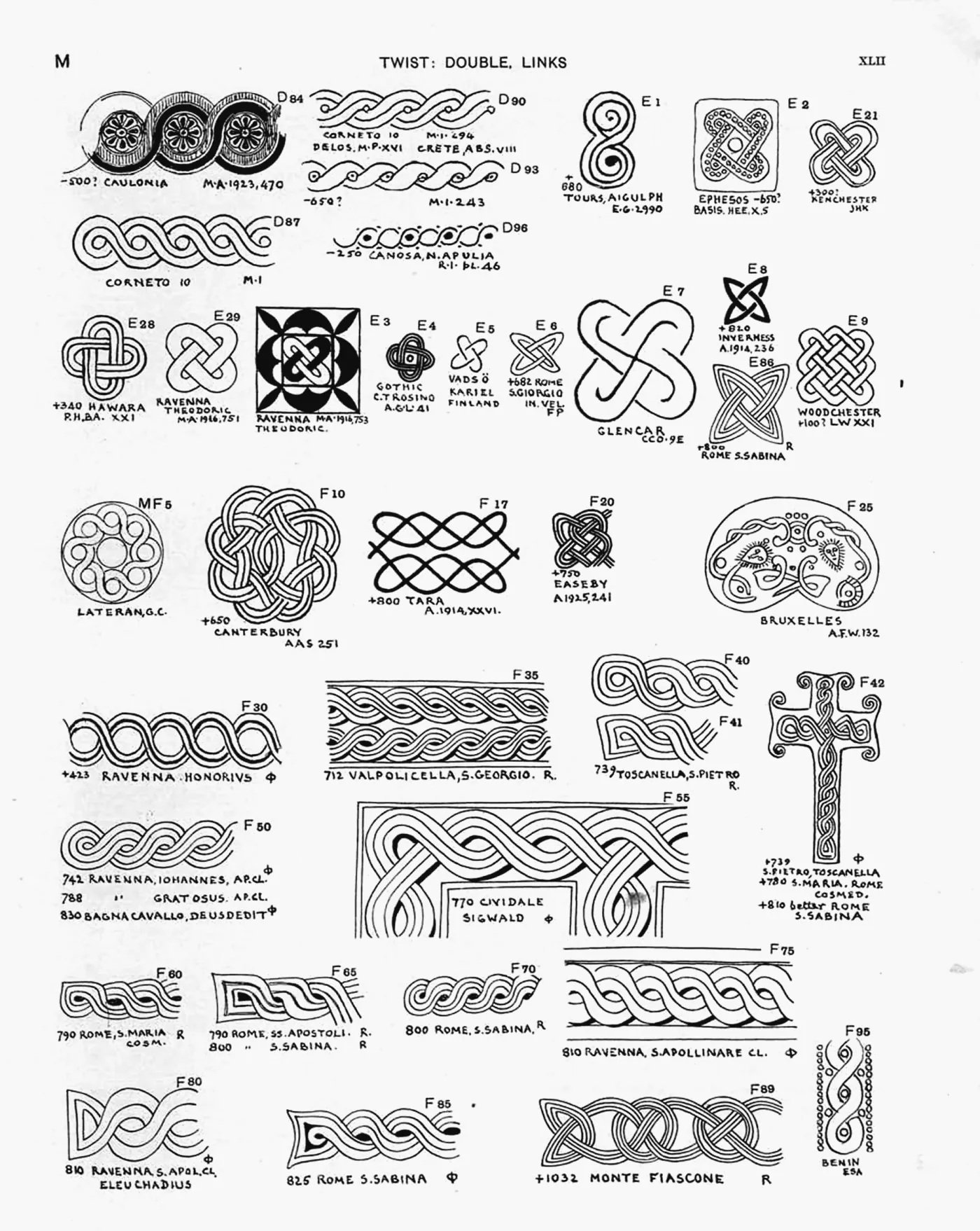
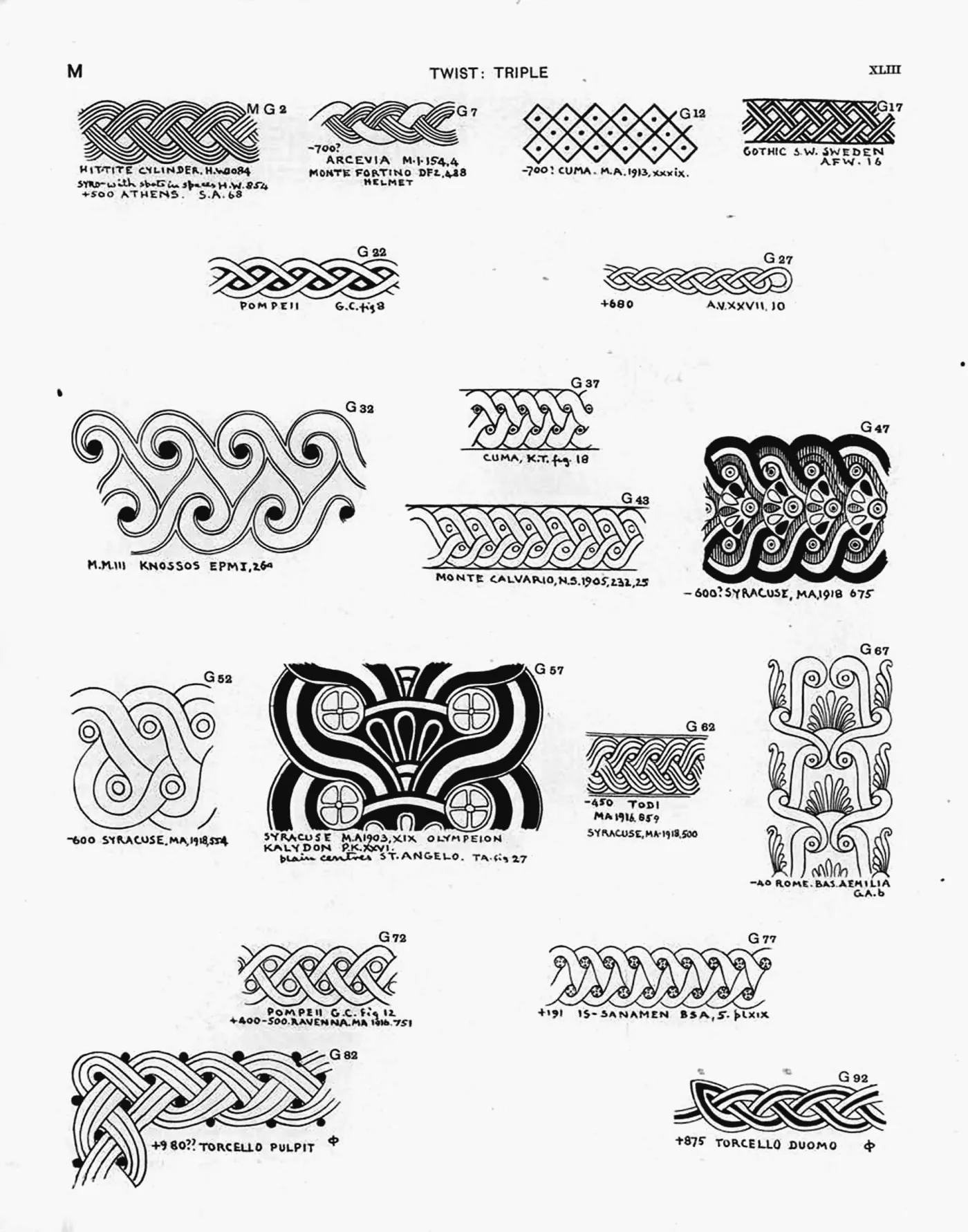
Plate XLII — Twist: Double, Links Zoom
Plate XLII · Class M

Twist: Double, Links

The double-line twist runs on at the top of the page, then the ME family takes over with links: closed knots of two or more interlocked loops, several squared off into panels, and E3 set as white strapwork on a solid black ground from Ravenna.

The MF family below is the double twist working as an architectural border, and it is dated hard, a ladder of Roman, Ravenna and north Italian church borders running from +423 to +1032, plus F42, an entire cross filled with guilloche.

Plate XLIII — Twist: Triple Zoom
Plate XLIII · Class M

Twist: Triple

The whole page is given to the three-strand twist, MG. Most of it is plain plaited banding, from Hittite cylinder work through Pompeii, Ravenna and Torcello, but the interesting entries are the ones that thicken it: G32 from Knossos, where the strands end in heavy rolled curls, and the black-ground panels G47 and G57 from Syracuse, where the plait is left white and every interspace is packed with quatrefoil discs, dotted ovals and palmette fans.

Plate XLIV — Twist: Quadruple, Sextuple Zoom
Plate XLIV · Class M

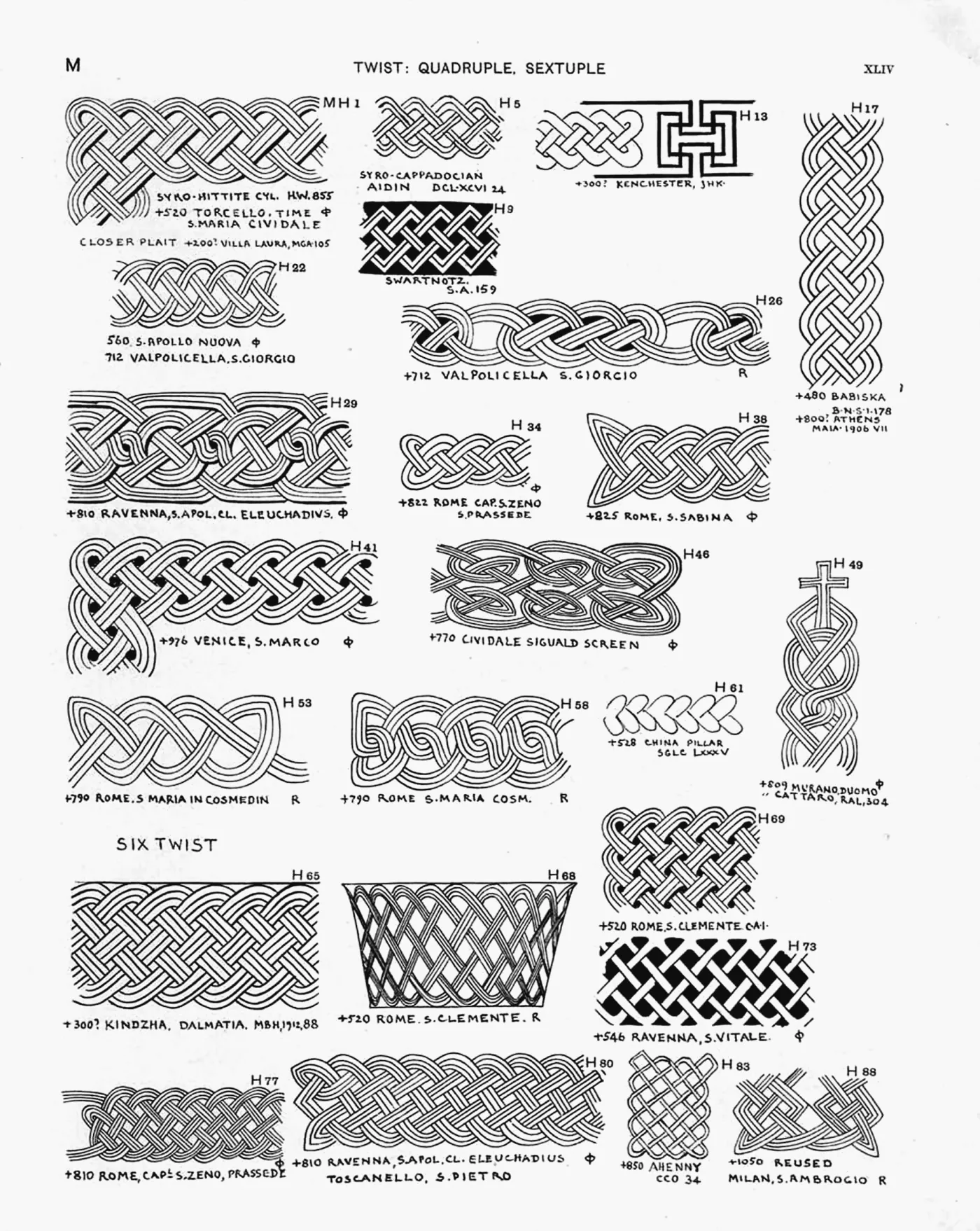
Twist: Quadruple, Sextuple

Four- and six-strand plaits, the MH family. The four-strand section runs from a Syro-Hittite cylinder at the top through a long file of dated Italian borders, Ravenna, Rome, Venice and Cividale, with H49 carrying the plait up the shaft of a cross and H13 setting it against a squared key panel.

Below the printed heading Six Twist the count rises to six; H68 from Rome, S. Clemente is drawn on a tapering panel rather than a straight band.

single, double, triple, quadruple, and then straight to six. no five-strand plait made the book.
Plate XLV — Twisted Circles and Squares Zoom
Plate XLV · Class M

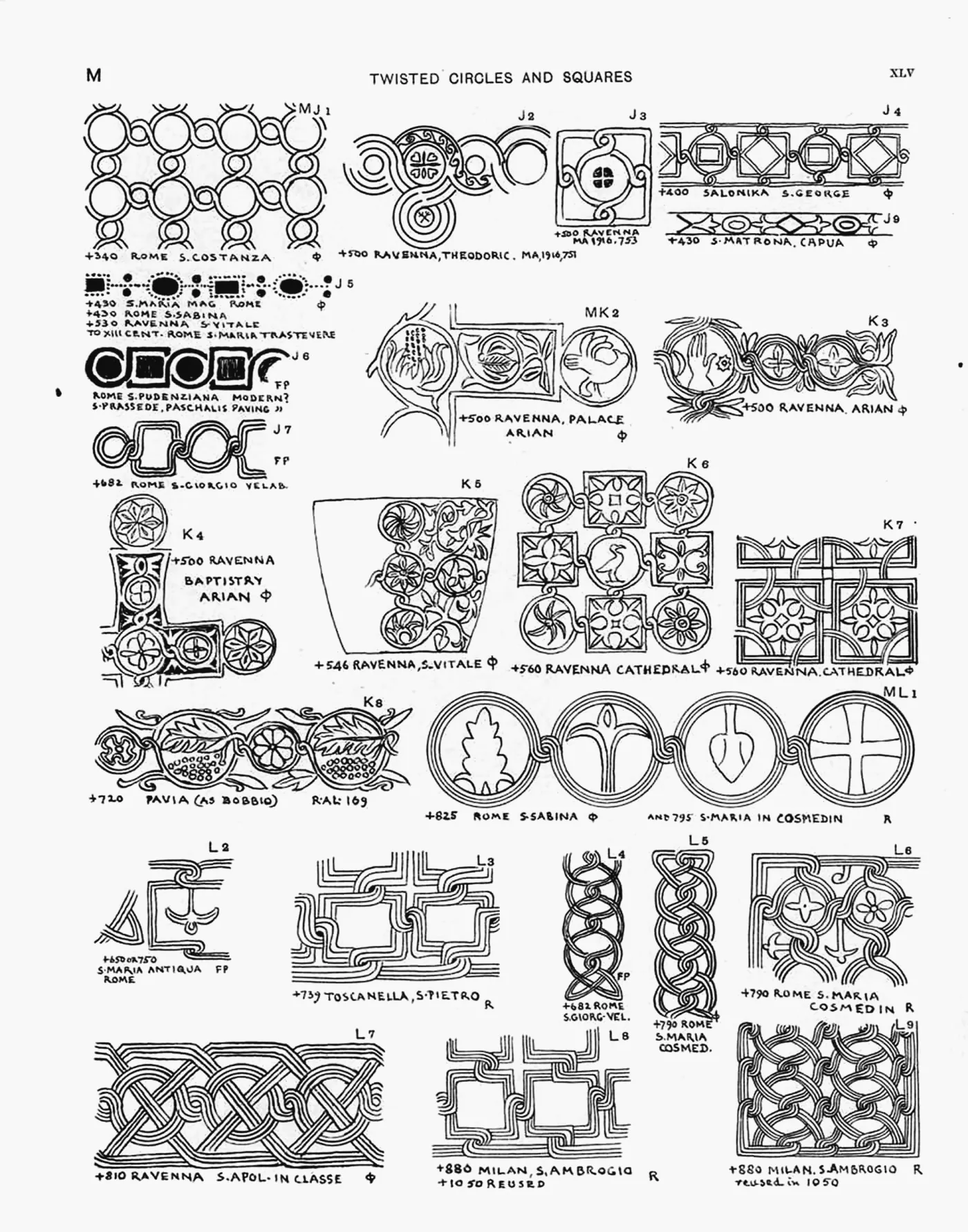
Twisted Circles and Squares

Twisted circles and squares, families MJ, MK and ML. MJ opens with a whole field of interlocking rings from Rome, S. Costanza, and reduces to J5 and J6, chains of discs and squares drawn as solid black.

MK foliates the rings, Ravenna work in which each roundel holds a leaf, a rosette, a bird or an outstretched hand, and ML takes them late, into square-cornered strapwork panels from Toscanella, Rome and Milan that box off blank rectangles between the bands.

Plate XLVI — Angular Plait, Norse, Lombard Zoom
Plate XLVI · Class M

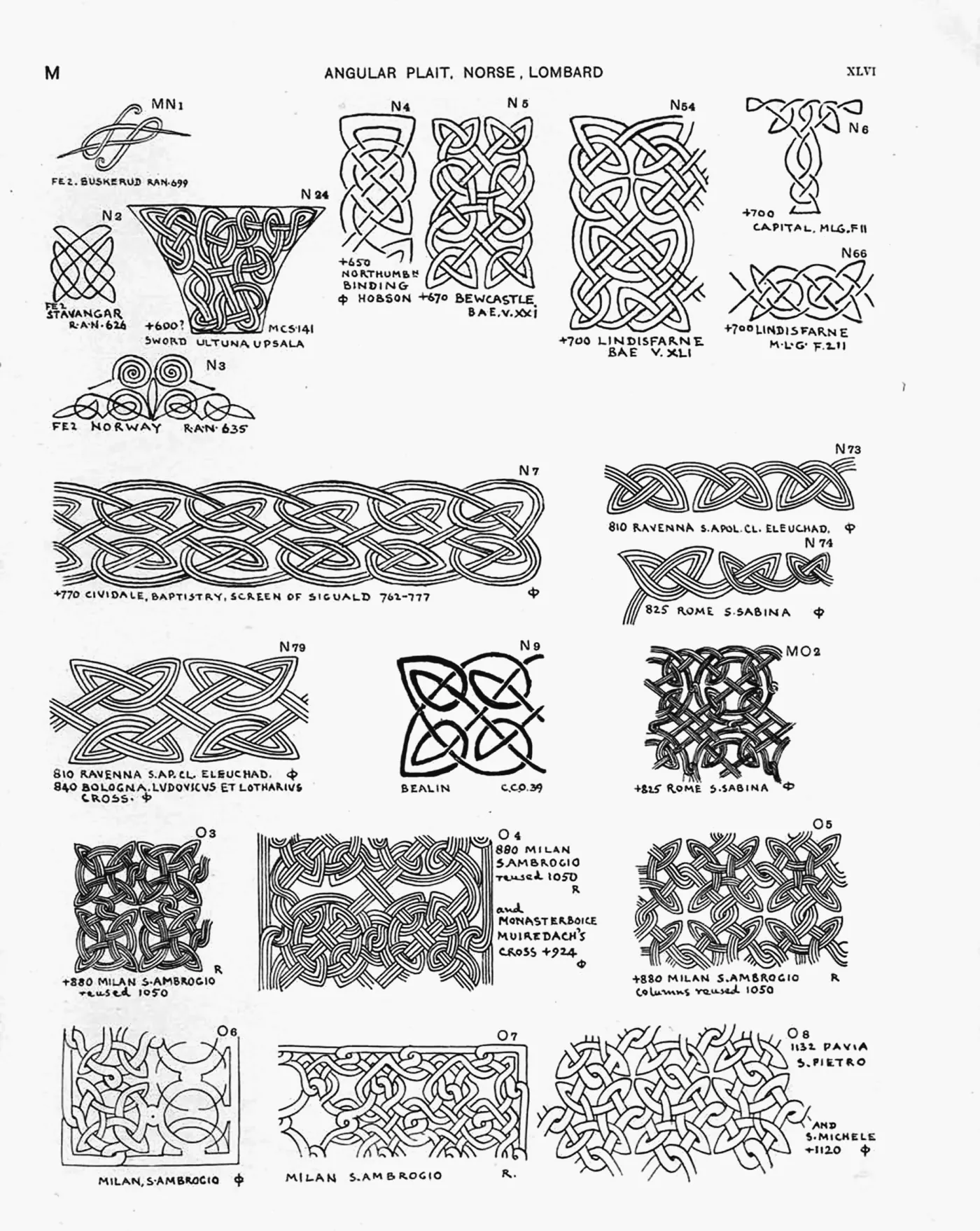
Angular Plait, Norse, Lombard

Petrie puts interlacing at home in Norway, MN 2, 3, and carried into north England by the Anglian invasion, MN 4, 5, 54. Ireland gets it later, and he is blunt that it has "no relation to the Celts", plaits reaching the British Isles a thousand years after they did. Angular interlacing "as in rush work" entered Italy with the Lombards; curves were folded in completely by +825, MO 2, and Milan passed the style on to Ireland in +924.

his best guess at where all interlace comes from: screens for partitioning tents.
Plate XLVII — Dragon Plait, Wire Looped, Chain Zoom
Plate XLVII · Class M

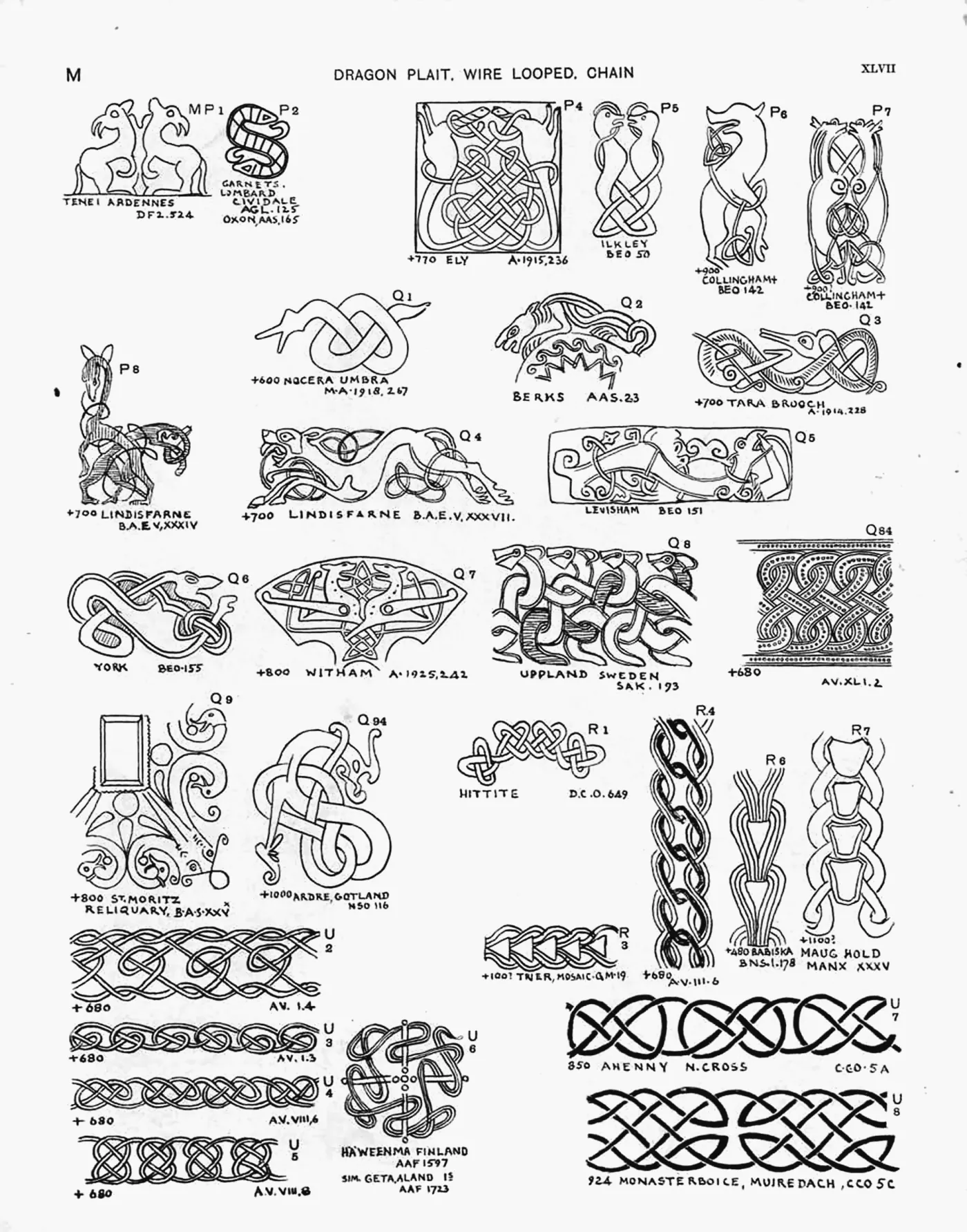
Dragon Plait, Wire Looped, Chain

The Norse elaborated interlacing into animals and dragons, MP and MQ: quadrupeds whose legs and tails dissolve into ribbon, an Uppland panel of almost solid dragon heads. In the complex dragon plaiting, MQ 8, Petrie shades one animal so its body can be traced out of the tangle, and from this came the figure-of-eight band, MQ 84.

Wire work was northern, MU 2 to 5, by +680, and copied in Ireland from +850 after the Norse invasion; even wire threaded on a chain was imitated, MR 4.

Plate XLVIII — Pentagons, Scales Zoom
Plate XLVIII · Class N

Pentagons, Scales

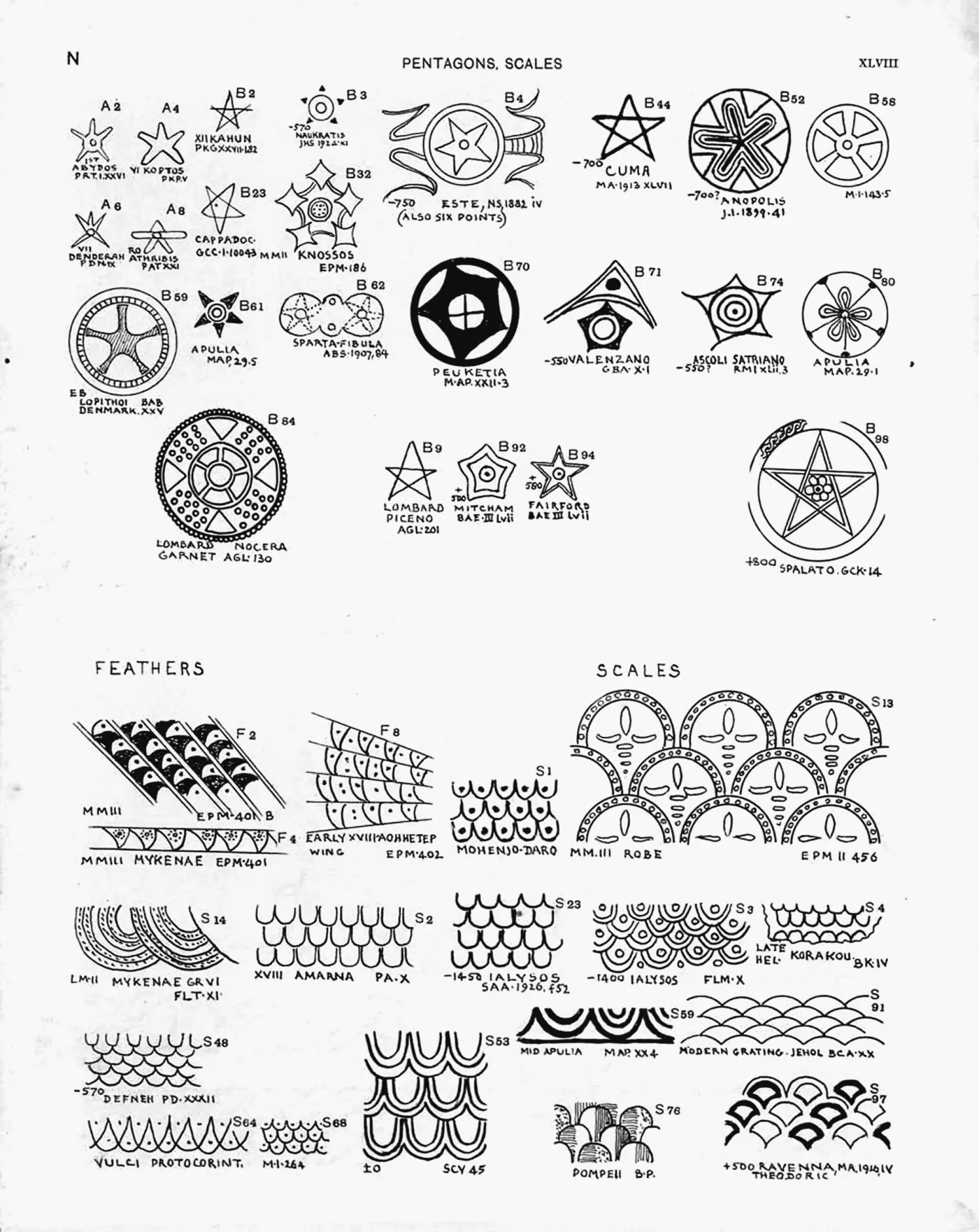
Class N begins with the pentagon: NA and NB run from scratched five-armed marks at Abydos and Koptos through regular pentagrams to stars set inside discs, a black-ground roundel from Peuketia, a Lombard garnet disc from Nocera with a dotted rim, and a pentagram at Spalato with a rosette at its heart.

The lower half of the page splits under two printed headings, Feathers and Scales: rows of overlapping scallops, plain, dotted, eyed, or drawn white on black.

the running head lists pentagons and scales, then a feathers section turns up in the middle anyway.