Decorative Patterns
Classes O–R · Plates XLIX–LVI

Circles, Skirls & Shields

The divided circle in every subdivision, whirligig skirls, the shields of Dacians and Scythians, and a plate given entirely to bands of balls.

Plate XLIX — Circles Divided Zoom
Plate XLIX · Class O

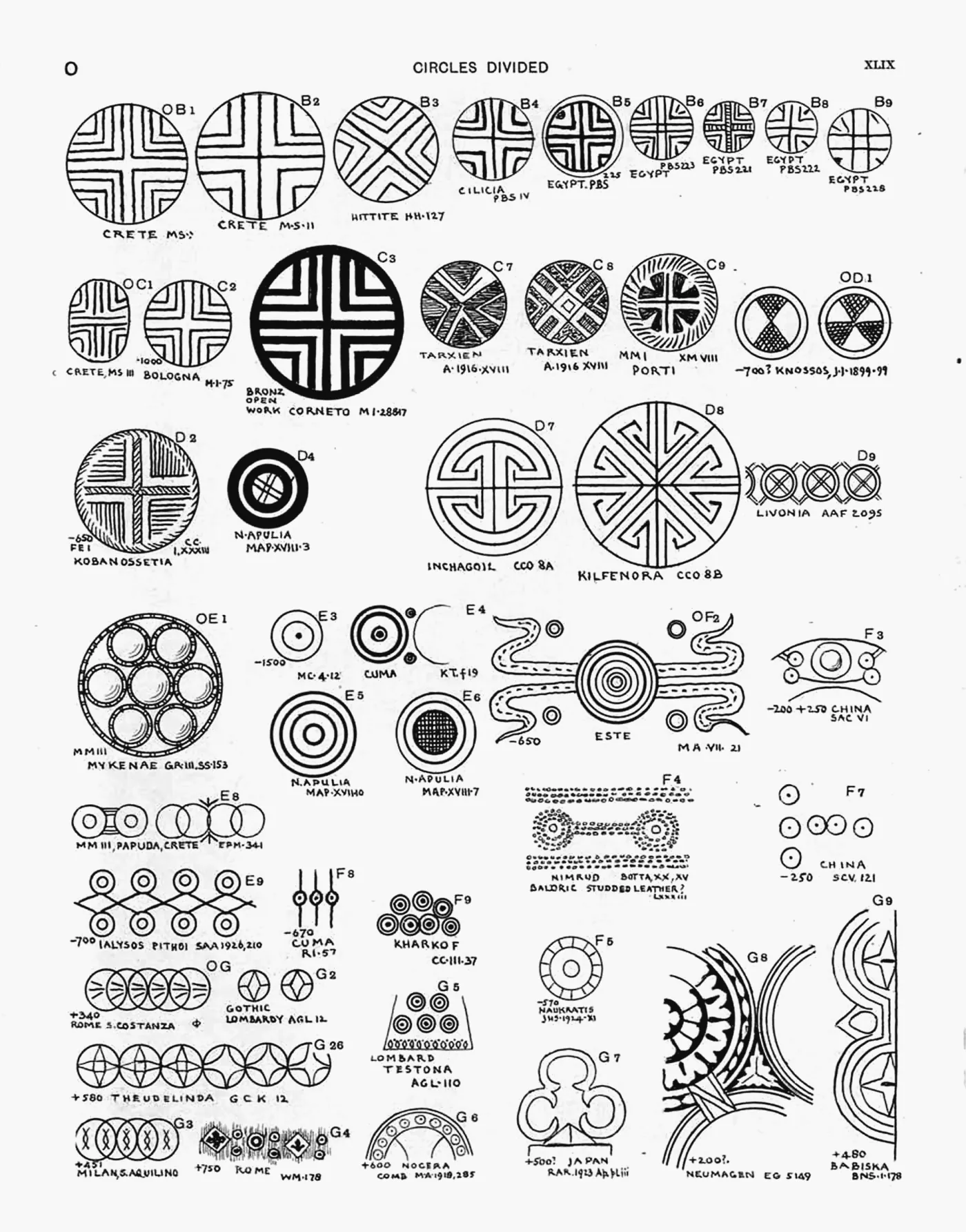
Circles Divided

Petrie left no note for this plate; it opens class O with the plainest case, a circle cut into four by a cross. The first row runs nine near-identical quartered discs from Crete, Cilicia and Egypt, the arms filled with key-fret. Below, the division loosens into hatched and openwork discs, two Irish cross-heads at Inchagoil and Kilfenora, then plain concentric rings and, at the foot, bands of linked circles.

One entry, the studded leather baldric from Nimrud, F 4, is drawn entirely in dots.
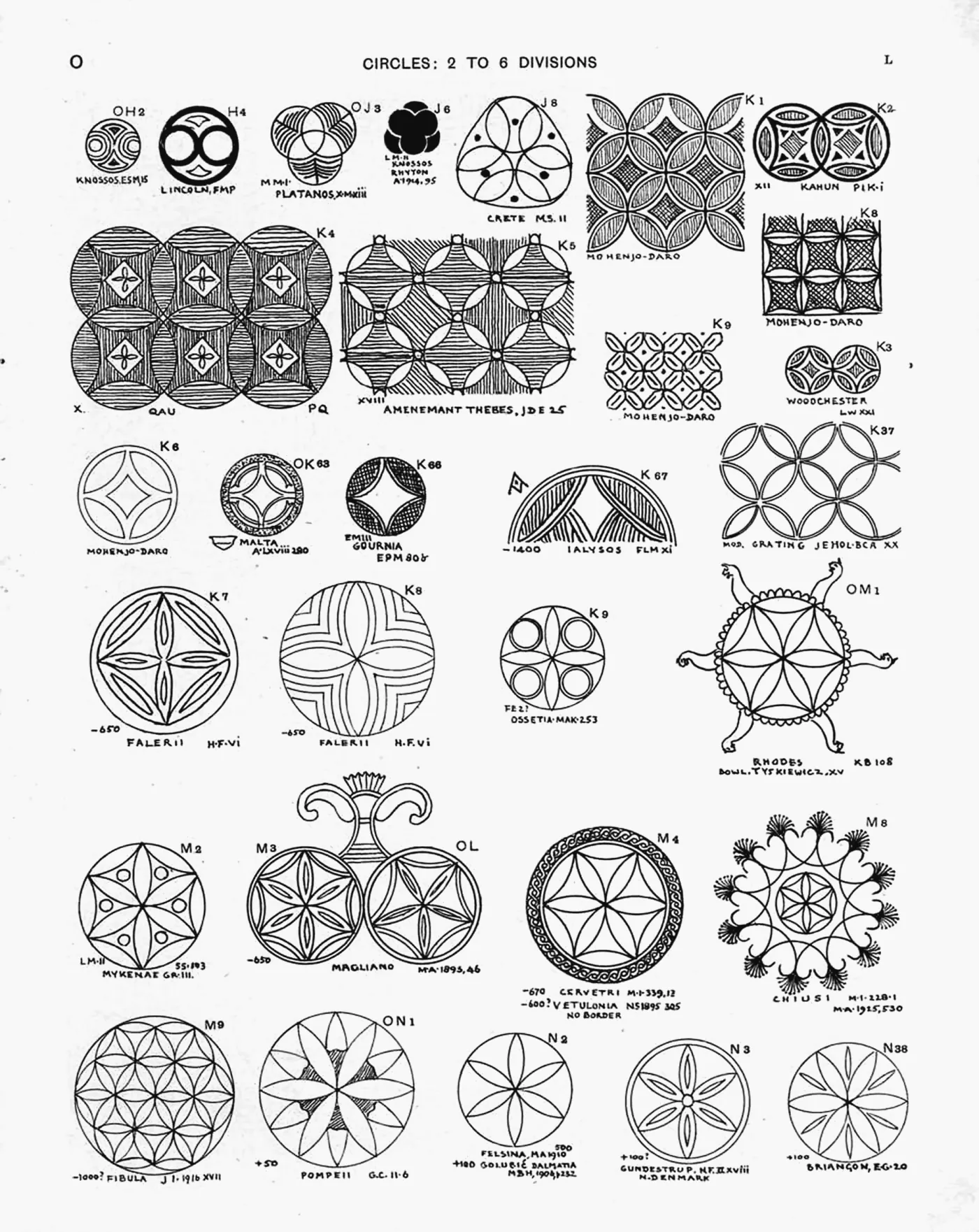
Plate L — Circles: 2 to 6 Divisions Zoom
Plate L · Class O

Circles: 2 to 6 Divisions

Petrie's whole note is a tool argument. A circle is divided by four in Egypt and early Crete, he says, "where compass-struck patterns were unknown"; but by six in Assyria, Syria, Greece and Italy, "owing to facility of division by compasses."

The plate runs in that order. Two- and three-lobed circles start the page, then interlocking four-fold grids from Mohenjo-Daro, Qau and a Theban ceiling, and finally a long run of six-petal compass rosettes from Falerii, Mykenae, Etruria, Pompeii and Gundestrup.

an entire ornamental tradition, decided by who owned a pair of compasses.
Plate LI — Circles: 6 to 8 Divisions, Skirls Zoom
Plate LI · Class O

Circles: 6 to 8 Divisions, Skirls

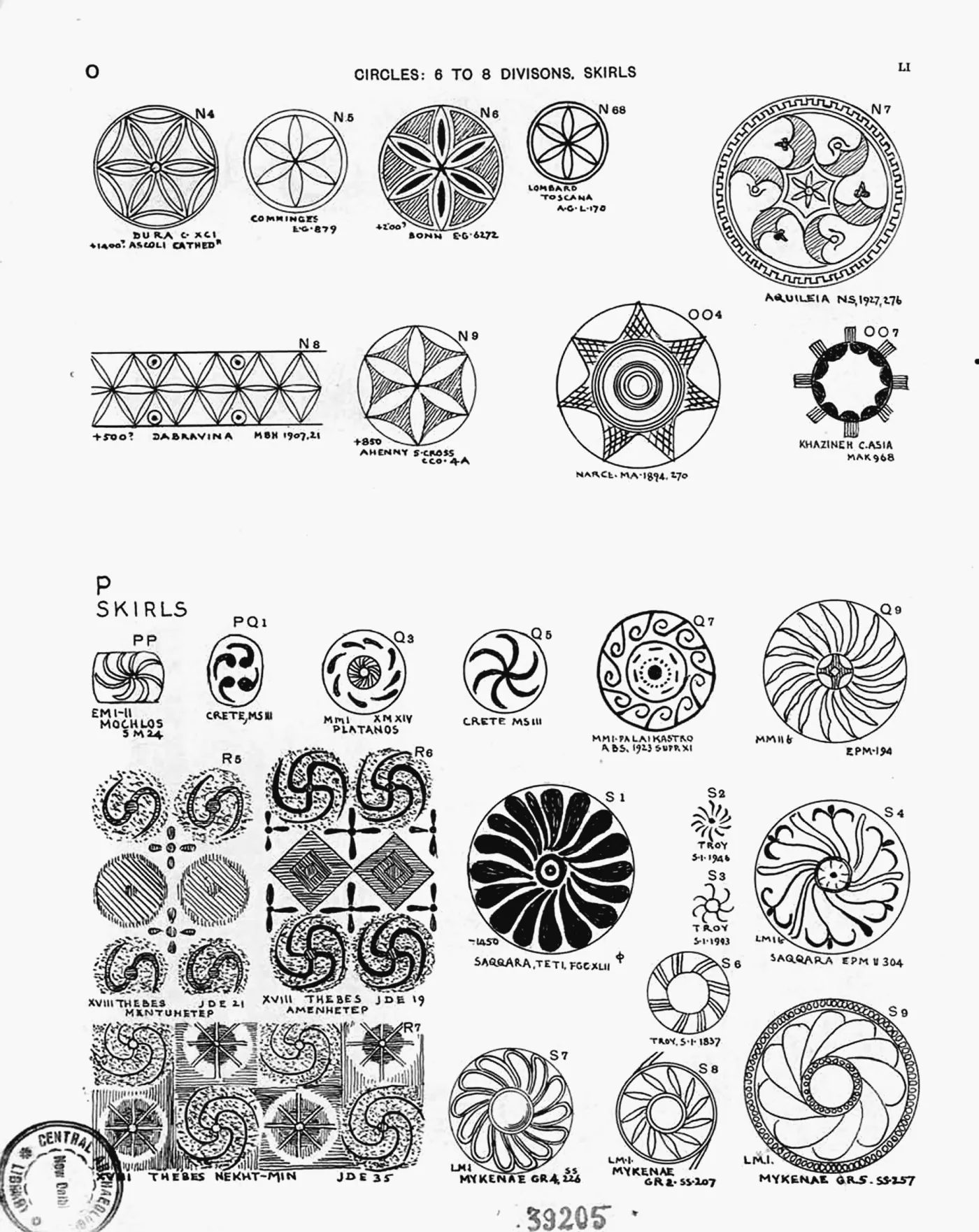
Petrie's note covers this plate and the next: the skirl, he says, "seems to be intended to indicate circular motion", and he points to a drawing of a chariot wheel on Pl. LII to make the case.

The top of the page finishes class O with circles of six to eight divisions, including a large Aquileia roundel. Halfway down, a hand-lettered heading opens class P, and the whirligigs begin: Cretan seals, three Theban ceiling panels drawn as stippled tiles, and rotating discs from Troy, Saqqara and Mykenae.

the running head drops a letter — "divisons". the plate before it manages the word fine.
Plate LII — Skirls Zoom
Plate LII · Class P

Skirls

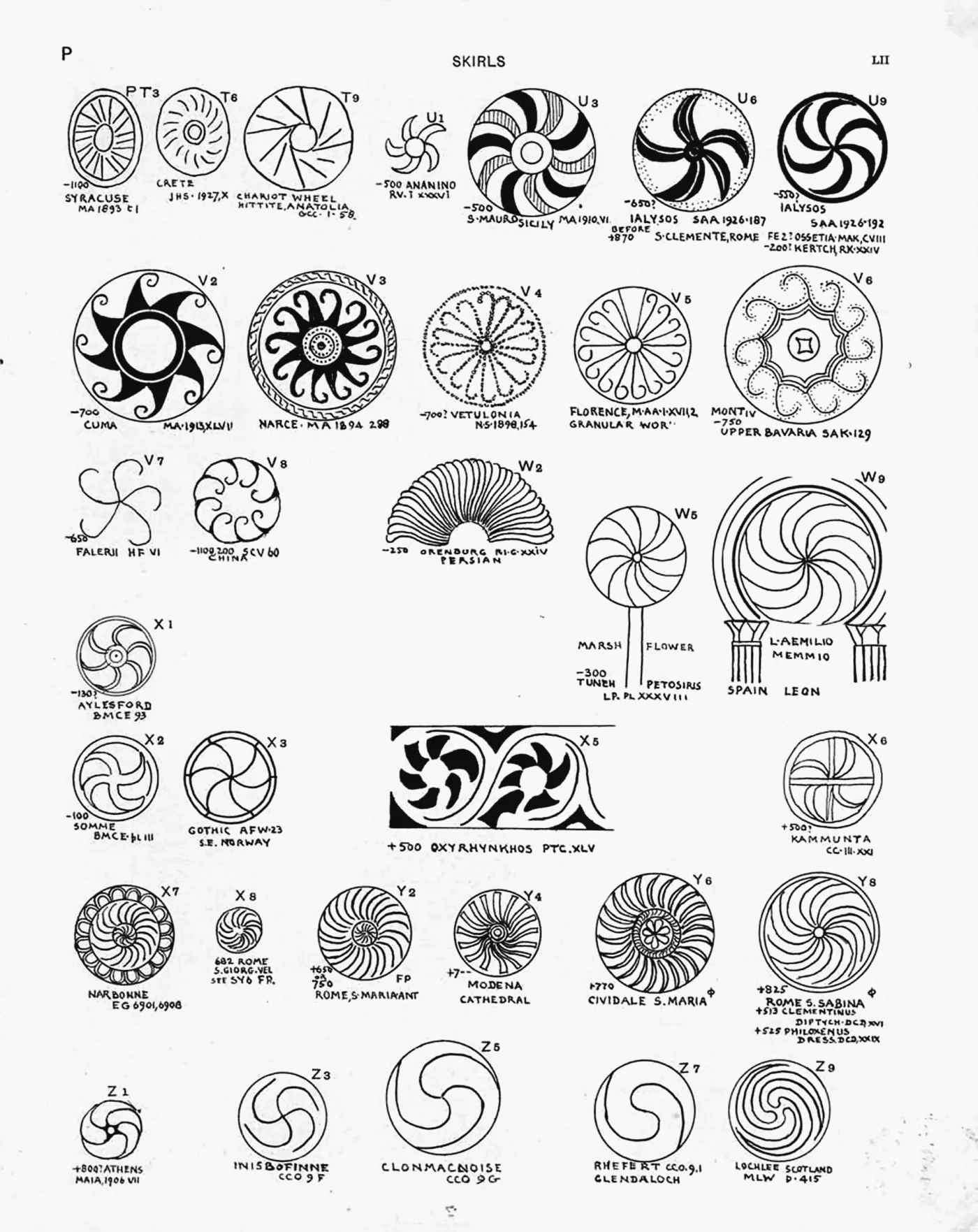
This is Petrie's second skirl plate, and here is the exhibit he cites: PT 9, a drawing of a Hittite chariot wheel from Anatolia. The skirl, he holds, "seems to be intended to indicate circular motion".

The page delivers it at full strength. A block of solid-black whirligigs runs across the upper rows — Sicily, Ialysos, Cuma, Narce — one Ialysos disc, U 6, set on a ground of fine stippled dots. Lower down the forms thin out into open Irish and Scottish spirals.

the solid black vanes make his argument for him. they will not sit still.
Plate LIII — Shields: Daci, Marcomanni, Galli Zoom
Plate LIII · Class Q

Shields: Daci, Marcomanni, Galli

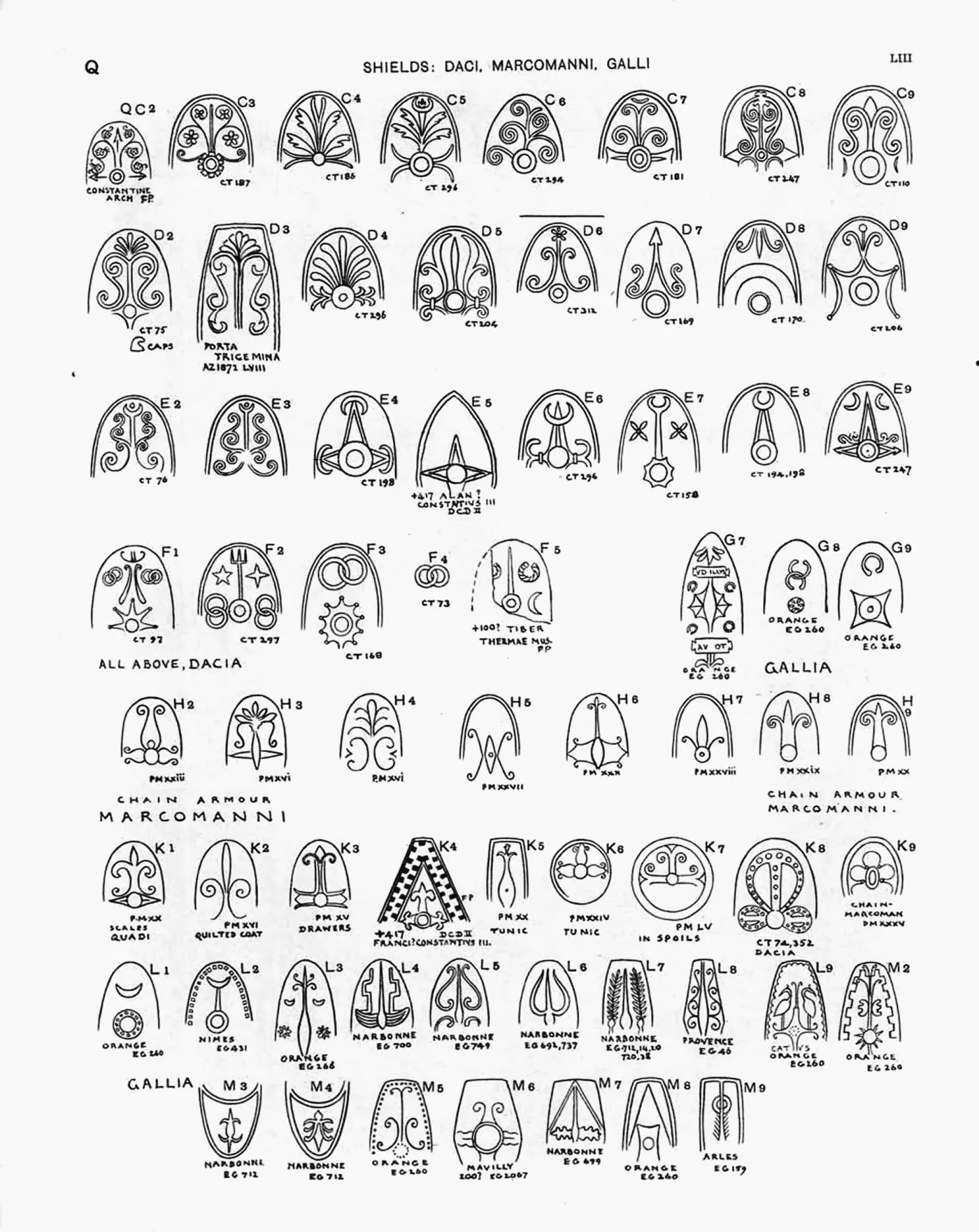
Petrie's reason for the shield plates is preservation: northern shields "yield much of the decoration which has otherwise all perished in their woodwork." The Daci on Trajan's column used vegetative forms, QC and D, and the crescent, QE. On the column of Aurelius the enemy in chain armour are the Marcomanni, QH, and the Quadi used scale armour of horn, QK 1.

The page is rows of small shield outlines, each with a palmette, scroll, trident or ring-boss, hand-labelled by group: Dacia, Marcomanni, Gallia.

Plate LIV — Shields: Roman, Gallic, Scythian Zoom
Plate LIV · Class Q

Shields: Roman, Gallic, Scythian

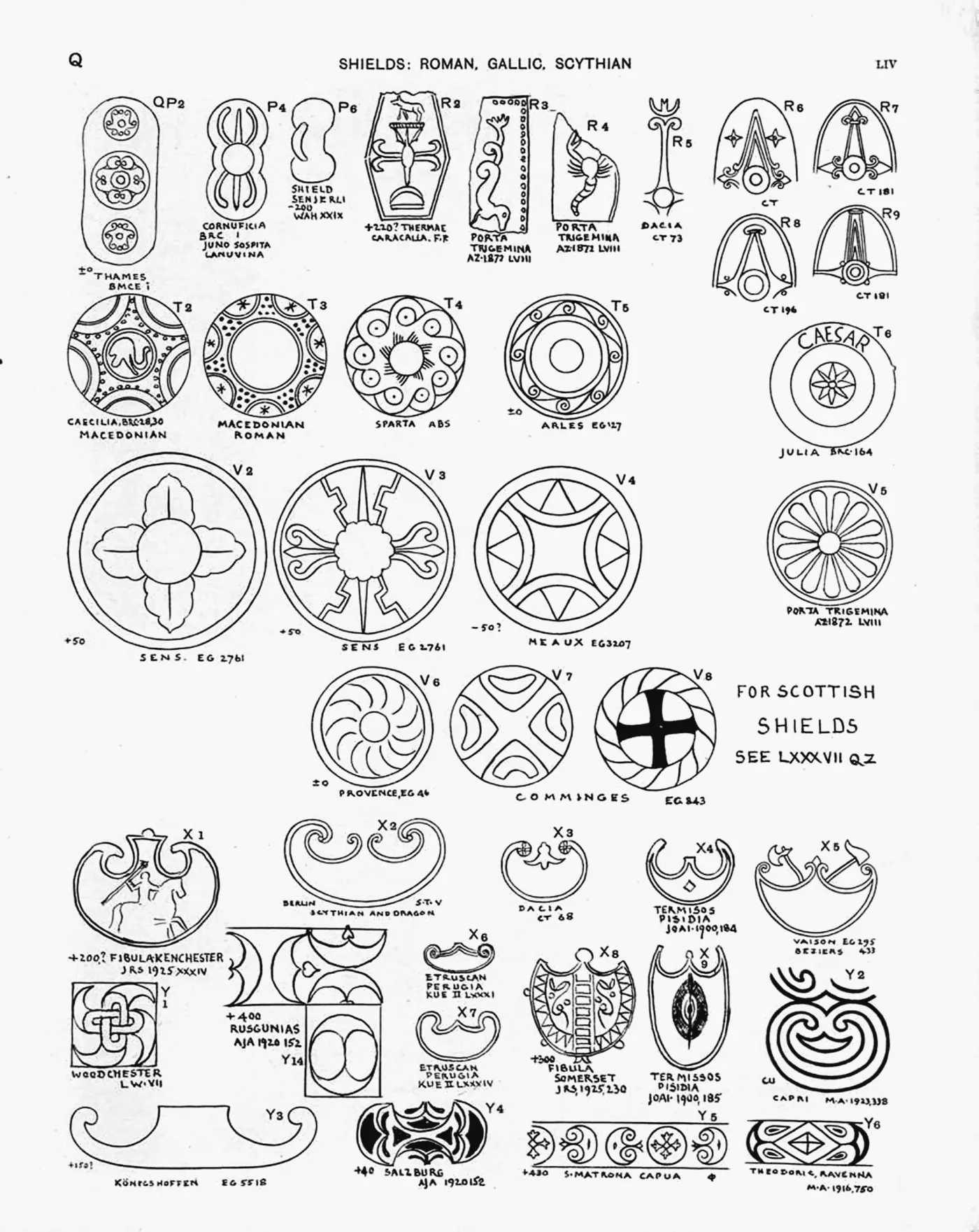
The note runs on from the previous plate. Petrie suggests the shields QR 2, 3, 4 may belong to Roman legions, and that the circular shield belonged to Greece and Gaul, QT and V. The Scythian type is identified by QX 2, but it became so fashionable in art that its appearance in Gaul, X 5, and Etruria, X 6, 7, proves little.

Above, oblong Roman shields with figures on them; below, round Gallic discs, one bearing a bold solid-black cross, and then the crescent-shaped Scythian forms.

the plate carries its own cross-reference, hand-lettered into a gap: for scottish shields see lxxxvii.
Plate LV — Band of Balls Zoom
Plate LV · Class R

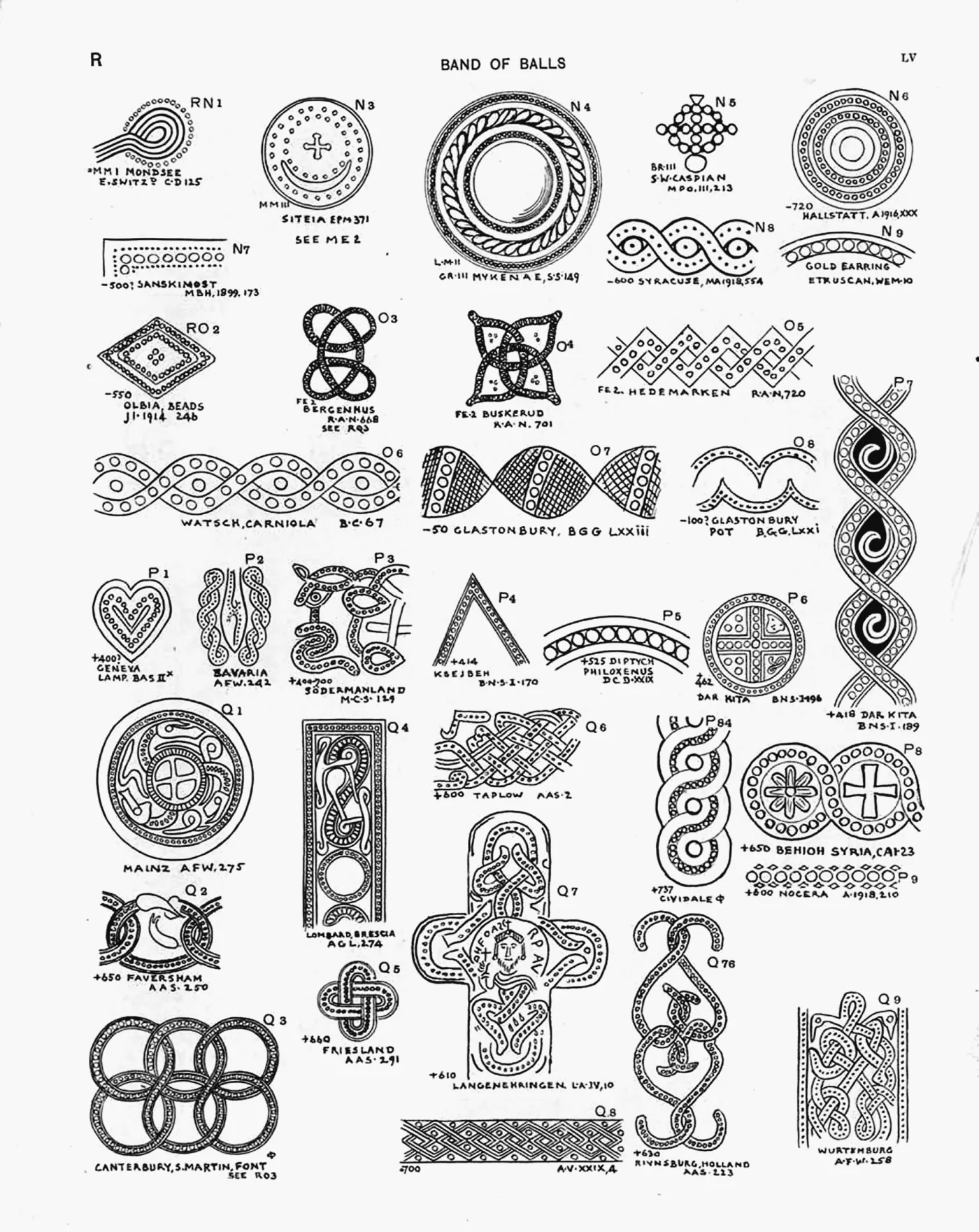
Band of Balls

Petrie is blunt about this one: the band of balls "seems poor as a design, but it was very popular in the north." It touched the south at Mykenae, RN 4, and reached north Italy under the Lombards, but never rooted there; it entered England with the Jutes, Q 2 and 3, and turns up rarely on early fonts.

Everything here is built from strings of small circles — knots, plaits, rings, a Canterbury font, and a cross from Langenehringen with a human figure at its centre.

he calls it poor design, then gives it a plate and a half.
Plate LVI — Band of Balls, Arches, Pillars Zoom
Plate LVI · Class R

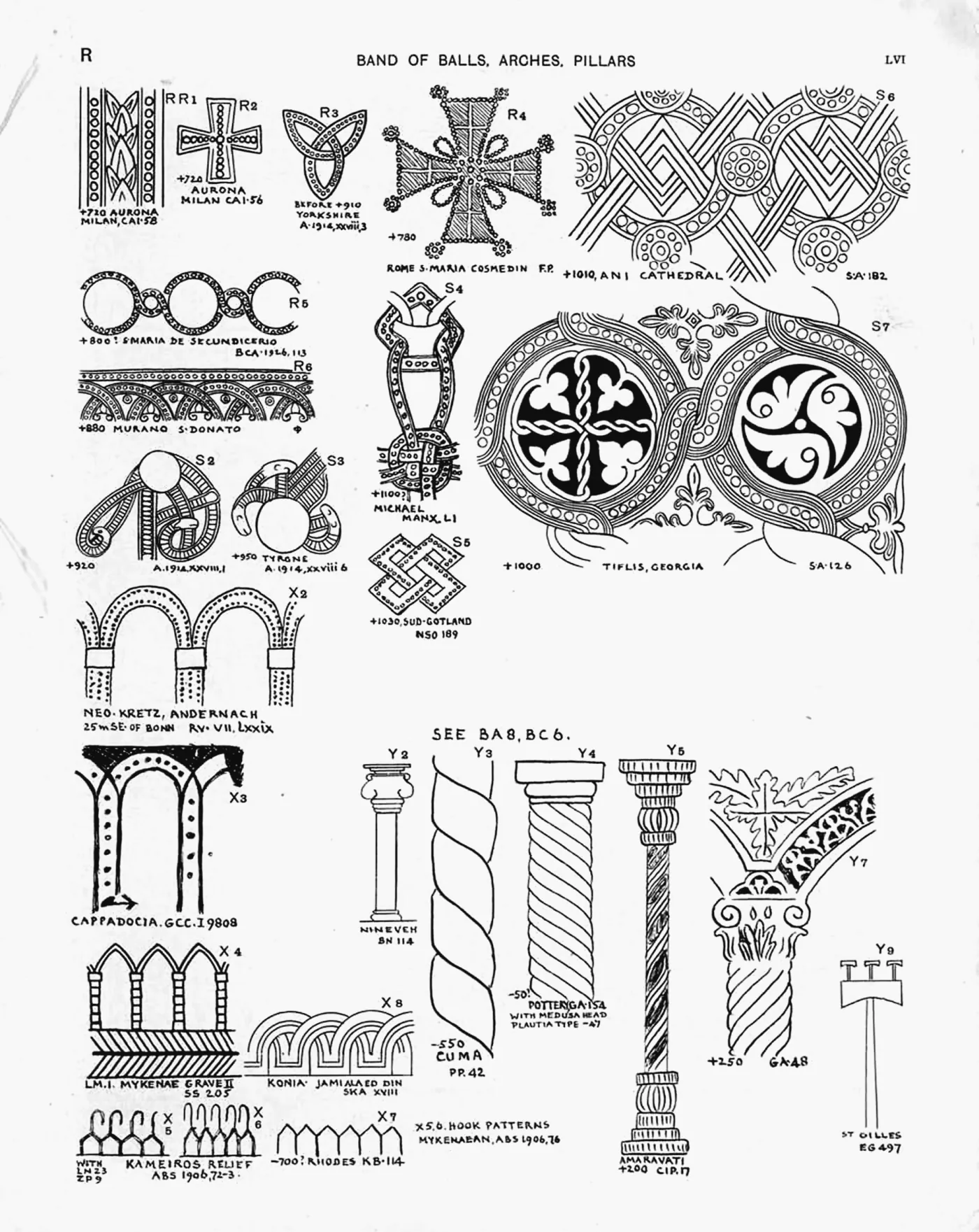
Band of Balls, Arches, Pillars

Petrie's note here is about arches. "A surprising feature, which has been overlooked, is the early use of the arch." Neolithic Germany had pillars and arches, RX 2, apparently of brickwork with stone capitals; Cappadocia shows very early arches, RX 3; and at Mykenae by -1700 there were actually pointed arches, RX 4. The spiral column was early at Mykenae, in Italy by -500, RY 3, and in India by +200, Y 5.

The top half still belongs to the band of balls, with two black-ground roundels from Tiflis.

a page that begins as beadwork and quietly turns into architecture halfway down.